
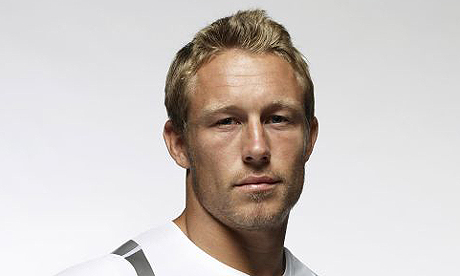
In April this magazine published an indelible photograph of Danny Cipriani and Jonny Wilkinson taken during England's Six Nations victory over Ireland. It was as poignant an image of the cruelties of succession in sport as could be imagined: the old golden boy was being put in his place by the new kid on the block. Three men - novelist Sebastian Faulks, the former France fly-half Thomas Castaignède and Kevin Mitchell, The Observer's chief sports writer - were asked to interpret what was going on in the two players' heads. Cipriani was easy enough - he was wholly involved in the energy of the game, orchestrating an inspirational victory, yelling at Wilkinson just as he would yell at anyone else. But Wilkinson, who had come on as a replacement at inside centre having been dropped and replaced at fly-half by the younger man, was far more difficult to fathom - his face was a complicated mask of humility and confusion, as if he desperately wanted to obey whatever Cipriani was telling him to do, but was still coming to terms with the curious idea that it was no longer him doing the telling.
Castaignède had been in both players' boots. He had been the mercurial debutant, and he had been the main man suddenly relegated to bit-part player. His analysis of Wilkinson caught some of that knowledge: 'You can see Cipriani imposing himself; on Wilkinson's side there is resignation, and perhaps a degree of mental burnout. He looks doubtful, as if he is wondering when the nightmare will end. But there is a side to Jonny which is beautiful as well; he had good things to say about his young rival after this game...'
When I meet Wilkinson a month or so after that picture was published, he still seems locked in that frame, somehow. He has the same air about him, of beautiful resignation, and the more I talk with him, the more I have a sense of what that look entails. It is something to do with mortality and something to do with fate, and a lot to do with resolution - was there ever a sportsman with more resolve than Wilkinson? No prodigy ever seemed as beset with fears as he was, and now that some of those fears are coming true - that it is all fragile, that it will not last for ever - he seems to be meeting them with a sense of relief.
You expect guardedness when you interview sportsmen these days, but with Wilkinson you get something else, not revelation exactly, but a kind of tortured introspection, a brief window on what it must have been like to be in his head over the past decade. We are sitting in an executive box overlooking the Newcastle Falcons' empty stadium. On the wall, inevitably, is a giant blown-up artist's impression of Wilkinson making a break, eyes intent on a gap in time and space; sitting in front of this image in an outsize leather armchair, the legend seems diminished, but his eyes are as sharp as ever. We talk first about his damaged shoulder, which will be operated on this month, causing him to miss the England tour to New Zealand. He shrugs. What is one more missed tour to a man who missed three-and-a-half years of international rugby union having won England the 2003 World Cup?
Wilkinson, who has just turned 29, used some of those lost years to read books on biology and physiology; his body, once compact with fearless promise, now seems something he views with academic interest, at arm's length. This injury is simple wear and tear: 'With the constant battering of the shoulder - and I guess I batter mine more than most - you get little ruptures in among the joint; I just need to get those sorted out,' he says (forgetting to mention that his shoulder has also long since carried the weight of the world on it).
There was a time, for the first six years of his professional career, when Wilkinson would look at older players who were injured and wonder what they were all so worried about: 'Why didn't they just get well and get out there?' But when it happened to him he understood all the anxiety. 'Someone comes into your position, is playing well, everything moves on without you, and you can't even get on the training field and work it through. You get down about it, people in the media are saying you will not be the player you were, and in certain important respects you will not, and then maybe you go too hard and get injured again...'
The idea of the player he once was is a critical one for Wilkinson. He talks of himself routinely in terms of befores and afters, of the 'old me' and the 'new me'. The disjunction began in the first match he played after dropping the goal that won the World Cup in 2003, when he badly damaged his neck playing for Newcastle and was out for nine months. He had felt the World Cup was a stepping stone rather than a culmination of anything; immediately after the victory he had gone back to his hotel room, alone, ignoring the celebrations and sat there on the bed thinking he had to reset his goals: 'It was like, "This is the start. Let's go now, let's get on with it." And then I lost the next three years.'
His only way to get his head around that theft of his prime, it seems, is to believe that it happened for a purpose. It forced him to grow, to take some of the pressure off himself. Had everything gone more to plan, he says, had he now been sitting opposite me with a decade of dominating rugby behind him, having not just edged over the international points-scoring record, but blitzed it four years ago, I would have been looking at a very different character.
'That Jonny Wilkinson would be unrecognisable,' he suggests. 'He would talk differently, dress differently, think differently. I would have been thinking hard about how every comment I made might be interpreted. I would have been in a mood because of something someone had written about me three days ago. I would have been looking at my watch thinking, "When will this end?"' The thing is, he was, back then, 'pushed around by situations instead of controlling them'. Control is very important to him. 'When you feel like that, you get pissed off about everything. Now, though, I can sit here happily and talk.'
I am not entirely convinced about that 'happily'. Wilkinson may be more at ease with himself, but it is a question of degree. At one point I ask him when was the last time he thought of rugby as a game, something he did for fun.
He thinks for a moment. 'I started when I was four,' he says, 'and up until I was 13, say, I just enjoyed it.'
He pauses, thinks a bit more, and then corrects himself. 'No, maybe a bit less than that, maybe until I was 10.'
But actually, that's not right, either. He creases his brow trying to remember. 'I think I am telling lies, actually it was about age four to about age six. By about that time - and I have researched this - I was already starting to create these fears about what it meant to fail. Before then I picked up the ball and I ran with it, you know, and after a game I might have been upset, but, like all kids, one minute I was crying, the next I was smiling.'
But at six that all changed. 'The smiles did not happen and the disappointments I just kept dragging with me.'
Wilkinson claims Boris Becker as his sporting hero, and you can see why the driven German might have struck a chord. Wilkinson was six in 1985 when Becker won his first Wimbledon title, and he was a fellow prodigy in waiting. I mention something that Becker's coach once said about him - 'Winning never lifts Boris as high as losing drags him down' - and Becker's own analysis of the idea: 'When you are a young man, you are looking for your own identity, and winning is a way of expressing yourself. When I lost I wanted to die. And because I thought in victory I became somebody, in defeat it followed I was nobody.'
Wilkinson is suddenly animated at this notion. 'That's it exactly,' he says. 'I always needed to push my expectations way above those of everyone else, but as people started to expect more of me it got harder and harder. If I beat my expectations it was, for me, nothing - that was where I should be - but if I failed it was crazily painful and it lasted so much longer. The lesson in losing always seemed so much greater than that in winning.'
Like all obsessives, Wilkinson developed strategies to avoid that pain. He was helped by his parents and his brother - the former Newcastle player Mark - who, you imagine, have spent a lifetime trying to get him to lighten up. When he moved to Newcastle from Surrey in the late Nineties, they all moved with him.
'I lived with my brother for eight years and that is what kept me going,' he says. 'When I came home from training and was mulling over a kicking session that did not go right or a game we had lost the previous Saturday, or when I was already getting nervous for the next one, he would drag me back into the now with some humour.' (The Falcons' website list the nicknames of Mark, who now coaches the club's academy: Sparks, Sparksy, Sparkster, Sparticus, Sparko.)
It was always a struggle, to get Jonny out of himself. 'Even in mini-rugby,' Wilkinson says, 'I lived for the next match with a kind of irrational fear. It was always like you have played 100 games, but the next one will always throw up something I don't know, or something will happen that will find me out.' Some of that fear was physical. 'I would always have a puke in the car on the way,' he says. He was playing in age groups four years above him. When he was 10 he played under-14s and, smallest by a mile, he would be standing there watching the opposition come out and thinking they were massive and be terrified.
When the game started, though, his only thought was that he should knock the biggest boy backwards, the ferocious defence he has never lost. 'I was in another body somehow,' he says of that process. The games were an arena in which he could overcome all the doubt.
'The most intense time of living in the moment is then. I would lose myself for a while. The problem was as soon as the whistle went for full time I would be worrying about the next game and it would all start again.'
I wonder if he came across other players with this level of neurosis? 'A few,' he suggests. 'But I always felt completely inferior in that respect. I was confident of my ability on the field, and that remains true now, but the nerves side of it - I always looked at other people and no matter how anxious they looked I always wished I was them. I envied anyone who had the notion of "what will be, will be". I never felt that.'
The cruelty of that fact is one of the things that was played out in that picture of Wilkinson alongside Cipriani. Rarely, if ever, had a player emerged in the England team with more chutzpah and instinct than the 20-year-old fly-half playing his first full international - we are speaking before the sickening ankle injury two weeks ago that has suddenly limited Cipriani's possibilities in ways that his rival knows only too well. Watching on, at the time, did Wilkinson envy him more than most?
'He was great,' he says, easily. 'I have always admired the ability to attack things without a preconceived feel, just naturally. If I ever spoke to Danny Cipriani, who is in his moment right now, about anything, I would say that to him: "Just keep it going, don't start trying to play up to anything but your own standards, and enjoy it as it is going on."'
It is that latter possibility in which Wilkinson feels he has made most progress. In the past, even when things went well, he mistrusted joy, because he felt that would take away from what he had earned. 'I was keeping my head above water and I believed if I said the wrong thing or if I laughed too much or if I didn't do enough practice I would go under. I kept telling myself and telling journalists and whoever would listen that the next step for me was always going to be enjoying it more, but that always stayed the next step, it never materialised. It was always "as long as I get through this game and we win then I'll be all right". But then there was always another game to get through.'
The injuries, he believes, were designed to jolt him out of that. He means designed, too; it was something like karma. The one thing he had feared most was losing time, and to that end he avoided as much pleasure, 'as many luxurious experiences', as possible; he thought he 'had to make those sacrifices to earn more of what he wanted'. While he was injured, in some of the darkest months, he had an epiphany of sorts. 'I just realised that two things are sure - we all come to an end one day and so will this career. And those sacrifices would mean nothing unless they came with a lasting peace. My identity had to be more than a rugby player.'
He talks, I suggest, like a Buddhist, and he confesses to spending a lot of time reading philosophy and religion, 'a big range of things about healthy living and spirituality' - some of it Buddhist, some Christian - to help him understand himself better. People have often talked about his monastic approach to rugby and he agrees it has always been a way of life for him, more like a martial art. His legendary kicking sessions, which could last hours - and his ritual preparation for penalties - were for him, he suggests, a form of meditation.
'Everyone talks about "being in the zone" as a sportsman. For me, that is the time when you stop constantly bombarding yourself with doubts and you just find yourself moving without telling yourself to move, or out there kicking without going through any process; you go with it. I've had that numerous times. I have this thing where I go out at four and think I have to be done by six and without any watch or clock if things have gone well I get back to the changing room at six o'clock to the second. You are just in tune with things, you feel like you know what is going on everywhere around you. Suddenly everything is easy.'
On the other times, when it's windy and raining, and he's forcing kicks, he can still stay out for as long as it takes to find some of that feeling, searching for rhythm, as if it might have been lost for ever.
This understanding of life as a process of personal growth and physical mastery (he hesitates to say enlightenment) has helped him get some distance on his career. Having seen him look so forlorn for England in the spring, the question is whether it has been at the expense of some of his former intensity. He laughs off that idea. 'I do more work than I ever did in terms of preparation and I care more than I ever did about the game right now. When I lose it still hurts like hell, but I have learned to embrace that hurt, and gain from it.'
Given this approach, I wonder how it felt for him to made a scapegoat in the Six Nations, the only man dropped after England's humiliating defeat by Scotland. He winces at the interpretation. 'It is the sort of thing I can't consider,' he says. 'I can't consider that coaches would ever do that to players, it's too negative. My immediate reaction to the news was: "OK, let's get out on the training pitch and see how good I can be." The thought of being singled out did not cross my mind.'
From most sportsmen this might sound like a platitude, but Wilkinson means it in earnest. He means everything else in earnest, too: that his new-found ability to relax might make forming relationships a bit more straightforward ('It is fair to say that I used to be tricky to live with'); that sometimes, rather than getting an early night, it might be an idea to have a beer with his team (he did so after the last World Cup final defeat - 'It just felt right, after what we had all gone through together').
He's never going to be laid-back, but the new-model Jonny believes he is better equipped than ever to take on the challenges ahead; he is not thinking of Martin Johnson's England, but there is no doubt that his former captain, now the newly appointed team manager, will know he can be relied upon.
With Newcastle in transition, people keep telling him that he should move clubs in order to win some trophies. That is not Wilkinson at all. 'It's not about trophies,' he says, 'it's all about playing your best for your team. That's all.' He reckons he has at least five more years and that, Cipriani or not, his best rugby may still be ahead of him. 'All you want is the opportunity to go out there and play, to attack the situation,' he says. You never know, but I have a sense he might even start to enjoy it.
Jonny Wilkinson: A brief history
1986
Aged seven, Wilkinson - born in Frimley, Surrey - has already been playing mini rugby with Farnham RUFC for three years and is learning to kick
1996
A promising sixth-form fly-half at his Hampshire school, Wilkinson is scouted by Steve Bates, coach at Newcastle Falcons, and joins the club in 1997
1998
Wilkinson makes his England debut aged 18, brought on as a replacement in a victory over Ireland. Makes his full debut two months later, in a catastrophic 76-0 pummelling in Australia
2001
Wilkinson impresses on his first Lions tour, but the series turns Australia's way when Joe Roff intercepts one of his passes in the second Test for a try
2003
The kick that made him a hero: with seconds of extra time remaining in a deadlocked final against Australia, Wilkinson lands a drop goal and England win the World Cup
2003
Suddenly one of the most bankable faces in British sport, Wilkinson appears in a string of adverts, including an Adidas spot in which he trades kicking tips with Becks
2005
Injury time: soon after returning from shoulder surgery, Wilkinson limps off against Harlequins having damaged a knee ligament. Over the next two years he injures his groin, his kidney and his other knee - as well as getting appendicitis
2005
He splits up with his girlfriend of three years, Sky Sports News presenter Diana Stewart, and begins his current relationship with family friend Shelley Jenkins (above)
2007
Although short of his best, Wilkinson helps England to a second consecutive World Cup final. His drop goal decides a tight semi against France, but England lose the final to South Africa
2008
Wilkinson becomes the leading international points scorer during the Six Nations, but as the team struggle he is dropped in favour of Danny Cipriani
Flashback
'I don't want to be a perfect musician; I don't need to feel I'm getting better every day. When I'm playing music it's probably one of the few times my mind goes quiet.' Wilkinson in Sept 2007
