
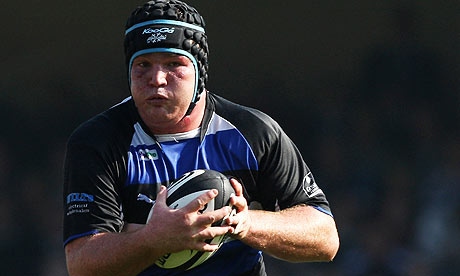
The three bodies that run professional rugby in England intend to adopt a joint policy on out-of-competition testing for illicit drugs after a year in which the England prop Matt Stevens was banned until 2011 for taking cocaine and four of his former Bath colleagues have been left facing a disrepute charge after allegations that they took drugs at an end-of-season party.
The Rugby Football Union, Premier Rugby and the Professional Rugby Players' Association, who today hosted a forum on illicit drugs at Twickenham, said the Stevens and Bath affairs accelerated their intention to introduce out-of-competition testing for cocaine, marijuana and the like – a policy no rugby country has yet adopted – rather than prompted it.
Stevens was banned after testing positive last December following Bath's Heineken Cup group match in Glasgow. Had he been tested the day before the game, it would have been only for performance-enhancing drugs, and he received the minimum ban of two years, which the RFU felt was draconian, because he could not provide any mitigating evidence, such as proving he had taken cocaine inadvertently, demanded under the World Anti‑Doping Agency's regulations.
"Players are desperate for this policy to be up and running," Damian Hopley, the PRA chief executive, said. "They feel the image and reputation of the sport have been put in danger and back a zero-tolerance approach to illicit drug-taking to prove that rugby does not have a problem.
"Out-of-competition testing would complement what Wada are doing and it would give us the chance to help any player who failed a test. Middle England was up in arms when he tested positive for cocaine and we were the ones to put an arm around him. I am not condoning drug-taking but he was treated the same as someone caught cheating."
The forum was addressed by officials from the Australian Football League, which has had out-of-competition testing for illicit drugs for the past five years, with players subject to hair testing after holiday breaks. An initial failure rate among Australian rules players of 4% has dropped to 0.8%. A first failure leads to counselling and treatment, a second to a more intensive education programme and a third leads to a ban of 18 matches.
Tony Adams, the former England and Arsenal defender who served a prison sentence in his playing days for drink-driving, told delegates about the need for player education. "I do not know if it would have changed my life but when I arrived at Arsenal there was no education and it is so important, for players, coaches, chief executives and support staff," he said.
Simon Kemp, the RFU's head of sports medicine, said: "On the back of Matt Stevens testing positive, the [RFU's] professional game board asked for a report which I wrote with Gavin Dovey [the union's anti-doping officer]. It highlighted a policy gap around illicit drugs and we made a recommendation, backed by Premier Rugby and the PRA, to canvass stakeholders' views and reach a consensus. Research has shown that cocaine taking among 16-to-34-year-olds, which broadly covers the professional rugby playing population, has increased in the last six years and we cannot afford to think that rugby has been immune from that. Fourteen players have failed tests in competition in the last five years, seven for recreational drugs, and it is likely that rugby players are not hugely different from their age-group peers. Is that a risk we can accept? We cannot afford not to do this."
Premier Rugby's rugby director, Phil Winstanley, said education of players regarding drugs was essential. "We are talking about a growing society problem and it would be arrogant to think that our game, which has young men with higher disposable incomes than the majority of the population, is not at risk."
Tovey said: "The rules that sports sign on to are not going to be effective in the negation of drug use. We are confident we can develop a programme that is world-leading. Many other sports are represented at the forum: we are all in the same boat but we recognise that drugs are a worldwide issue and we have to close the gap that currently exists in testing."
Kemp said that cocaine usually stayed in a user's system for three days and that an out-of-competition testing programme would test players at the start of a week. No date has been set for introducing the policy but Winstanley said the attitude was the sooner the better and that it would be administered centrally, not left to individual clubs to decide sanctions.
There are anomalies to be sorted out, such as what would happen to players based in France if they failed an out-of-competition test while on England duty, but Winstanley said: "We can learn a lot from the experience of bodies such as the AFL. This is all about the welfare of players because it is unacceptable for us as employers to ignore the health risk of drug taking. We are committed to introducing this testing as soon as possible and we may follow it with a policy on alcohol."
