
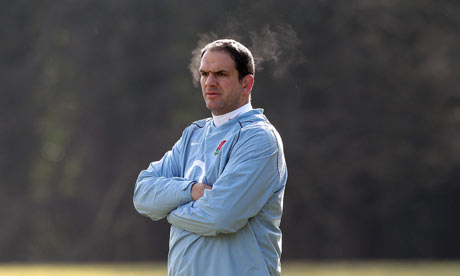
It has been the same old story for seven consecutive years. How, people keep asking, can a nation with England's enviable resources again be out of the running for a grand slam, if not the title, with two whole Six Nations weekends still remaining? Coaches and players come and go but not since 2003 have the erstwhile world champions won three successive games in the championship. To blame the current regime alone is to ignore deep-rooted issues elsewhere.
Events at Twickenham, for instance, may have less bearing on the England squad's medium-term future than two eye-catching scorelines from the Guinness Premiership at the weekend. Leeds Carnegie's 26-10 win over Wasps, coupled with Gloucester's 47-3 thrashing of Sale, has transformed the Premiership run-in. Suddenly the Sharks, without a win in their last seven games in all competitions, are staring at the unthinkable spectre of automatic relegation. Leeds, conversely, have prised open the theoretically padlocked trap-door. The bitter struggle to avoid the drop to the Championship – with Worcester also involved – will consume all parties for the next two months.
Depending on your perspective this is either enormously healthy or a fatal distraction. Premier Rugby prides itself on sustaining interest at both ends of the table from start to finish and has the attendance figures to prove it. Every game matters, every centimetre has to be scrapped for. In the muddy trenches of Stockport and Headingley a trans-Pennine war of attrition will resume on Sunday. Any resemblance to the carefree, sunlit try-fests of the Super 14 is, at best, fleeting.
If international rugby was purely about grinding out results on ploughed fields week after week, England would be a match for anyone. But as Ireland once again demonstrated on Saturday, it is the cobra-strike rather than the bludgeon which settles today's major games, both at Test level and in the Heineken Cup.
Other than the end-of-season play-offs, played on firmer, faster surfaces, the majority of English internationals play relatively little of the high-velocity rugby that occurs when teams are more concerned about scoring than hanging on for a losing bonus point. Their experience of situations which might help them react positively when opportunity beckons in a white jersey is limited.Too many, as a consequence, develop safety-first instincts under pressure. Anyone would if forever looking over the shoulder fearing the worst. In France's Top 14 relegation has less impact because of a greater disparity between the top and bottom clubs in the league, which is less attritional on the players as clubs boast larger squads.
Clearly there are other factors in England, not least the weather. Who would also want to stop Bristol or Exeter Chiefs, the two favourites to feature in this season's inaugural two-leg Championship play-off which will settle promotion, from chasing their dreams? But what about all those loyal club spectators who already have to accept their best players being absent on international duty for large chunks of the year? And credit to opponents like Ireland, with far fewer professional players, who consistently overcome their relative lack of numbers with clever man-management and old-school rugby nous.
It is no real surprise, though, to hear whispers that the balance of power between the Premiership clubs and the Rugby Football Union is back under discussion. An eight-year agreement between the two parties is supposedly set in stone but the economic climate is very different now. Nor, so far, have the painstakingly negotiated player release periods led to a sharp upturn in England's form and results, nor reduced the injury toll among national squad members to any huge degree. "We're playing too much rugby and people are going to have to recognise that," said a senior Twickenham insider last week. "The structure just isn't right and eventually we're going to have to get it changed."
The financial woes sweeping through football may also soon be lapping at rugby's feet. Most estimates suggest that four Premiership clubs are financially sound and another four are close to breaking even. The remaining four, however, are still a long way from profitability while the balance-sheet horrors of Championship clubs this season are well documented. One RFU hawk fears the situation could get worse: "The Premiership is not sustainable. They're haemorrhaging money and at some stage one or two of them are going to go bust."
In such a fragile environment the hammer-blow of relegation becomes ever more worrying. If Sale cannot stop the rot, it may also leave England squad men like Mark Cueto, Mathew Tait, Andrew Sheridan and Charlie Hodgson with a stark career choice to make if they wish to be involved in next year's Rugby World Cup in New Zealand. It makes the thorny dilemmas facing Martin Johnson feel almost insignificant. Not all England's problems should be laid at his door.
