
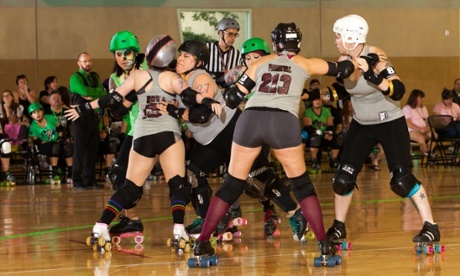
It’s an austere scene inside Thunderbird Roller Rink. Gaudy hues of luminous green and blue stripe the interior walls in two thick banks. Tarpaulin sags from the roof over a rain-induced hole, the intermittent streamers shimmering overhead seemingly an antidote to the unsightly spectre. The dank yet cosy ambiance as the girls of Assassination City take to the floor of this 40-year-old Plano institution seems to belong to the 1980s.
Successive owners have struggled to keep the suburban arena a short drive north of Dallas open for some years. The 1970s, disco-infused heyday of roller-skating faded with the economic and cultural winds of change in the 80s. But the humble roller skate is experiencing something of a resurgence. Nostalgia plays a part. Counter-culture, too, perhaps. But the renewal owes much to its chastened old bedfellow, the muscular emblem of the roller rink that in many minds is cloaked in female fury, smeared with their blood and dotted with their bruises. The kitschy world of roller derby.
But this is neither your mother’s nor your grandmother’s version of the sport. Assassination City Roller Derby, a league of four home teams, is part of a grassroots movement that emerged out of Texas capital Austin in the early part of the 2000s. But not on the traditional banked track of derby, the kind that invaded TV screens in the 70s and 80s. This new iteration involves the new world of a flat surface. Rooted in bootstrap feminism and sporting integrity, here gimmicks, elbows and unabashed fighting no longer apply.
Or as Amanda Warner puts it, flat track still exhibits some of the sartorial flourishes of past renditions. Hot pants abound. The occasional set of fishnet stockings make an appearance. But this go round, sport and competition reign. “We have rules, we have regulations,” says the 29-year-old marketing professional from Plano. “We serve penalty time in the penalty box. You can only hit each other with certain parts of your body, so there’s no throwing elbows or punches or anything. So I feel like it’s safer in the sense that it’s not all, ‘I’m going to punch you and pull your hair’ or anything like that. But there is always the risk for injury. You know, we’ve had broken ankles, concussions. It’s kind of common but it’s a lot safer than it used to be. I don’t think we play to try to intentionally get injured, but it’s the risk that we take.”
The re-boot spawned the new Women’s Flat Track Derby Association (WFTDA), a governing body that claims hundreds of local leagues worldwide. Still today, derby is often viewed through a WWE-like prism. The basics remain. Two 30-minute halves. Teams of five, one jammer and four blockers. Points are scored for each opposing team member passed by a jammer. But old truisms that it is staged, the results pre-determined, stalk participants. Yet the worst of the faux, lowbrow visage that characterized this piece of Americana in the 20th century are fading. Roller derby’s Dark Age witnessed violence on a brutish scale. Not now. More than a decade into a Renaissance, there are competing governing bodies laying various claims to primacy.
Which is where things get a little complicated. There are different nuances to the rules depending on the governing body along with diverging rites of passage. USA Roller Sports, or USARS, the national governing body of all roller sports in the United States, is the chief foe of WFTDA. Recognized by the Fédération Internationale de Roller Sports(FIRS) and the United States Olympic Committee, USARS seeks to unify the various forms of derby – juniors, men’s, women’s as well as groups who continue to play on the traditional banked track – under a unified umbrella. Attempts for Olympic inclusion have been mooted. But faint hopes derby could make an appearance alongside other roller sports at Rome 2024 seem to have abated.
AJ Epp, USARS roller derby coordinator, is circumspect. “We are pretty far away from that,” she says. “The sport would first have to be better recognized.” Progress might mean stepping stones such as the Pan-American Games and the AAU Junior Olympics, Epp mused. In that vein, earlier in June USARS announced derby would form part of the 2016 version of the latter.
Austin-based WFTDA takes a more skeptical viewpoint, believing in developing derby from the ground up. They buy into inclusion at international events. Girls of the WFTDA stripe take part in the Roller Derby World Cup, staged by Blood & Thunder magazine, which covers contemporary women’s roller derby. The inaugural event, staged in 2011 in Toronto, saw host Canada defeated by the USA in the final. The last, held in Dallas last December, was witness to the USA overcoming England to win. The next is slated for 2017. There, the image of a sanitized sport for the 21st century is complete, a quintessential sporting look resplendent in the uniformity of appearance among the different nations.
But for WFTDA, for now at least, the Olympics is a hazy dream. “It’s not clear whether FIRS or their US branch, USA Roller Sports, is actually hoping to see roller derby in the Olympic Games,” says Juliana Gonzales, WFTDA executive director. “FIRS been actively attempting to get speedskating into the Olympic Games program for a few decades, without any success. It seems unlikely that FIRS would invest the kind of money or political leverage necessary to advance roller derby into the Olympic Games, nor does it seem an incredibly likely choice for the IOC to include at this time.”
There appears to be détente of sorts between the governing bodies but the philosophical divide seems vast. “Certainly,” adds Gonzales, “both FIRS and USARS are seeking governance of roller derby right now, and it’s evident that claiming roller derby under their umbrella might benefit their position with the IOC; however, they don’t seem to be aiming for the inclusion of roller derby itself in the Olympic Games.” Still, there are clashes. For instance USARS objects to the use of the Team USA moniker by the United States team at the World Cup, says Epp, since the use was unsanctioned and the emblem belongs to the body officially endorsed by the US Olympic Committee. WFTDA, meanwhile, is focused on grassroots development and the prominence of participant voices.
Nevertheless, across the many forms of derby there are reputedly now more than 1,500 local leagues worldwide, lending some credence to the idea that derby is an emerging sport.
Away from officialdom, the modern aesthetic continues its quest to grow and alter perceptions. And increasingly that means strong challenges to old-worn sensibilities. Doctors. Nurses. Lawyers. Scientists. Teachers. Participants hail from a surprising array of professional backgrounds. Some profess to inhabit double lives, choosing to separate their daily grind and the people who populate it from the nights they spend under nommes de plume such as Cannibal Cupcakes and Streetcar Named Destruction on the derby track.
Cannibal Cupcake is the track name of Warner, the marketing professional from Plano. She’s a relative newbie, two years ago joining up after getting the bug watching derby in her previous home of Austin, spiritual center of the juggernaut. “I bought skates and I was the worst skater ever. I only roller-bladed as a child, which is a lot different than the quad skates, so I was like a Bambi on wheels, learning to walk,” she says. Grounded in the roots of the sport, she was attracted to the camaraderie of the derby network. More than the competition, Warner is attached to the idea of how the women of flat track are self-sufficient, pulling the strings of the entire organization, running the league as a business entity under their own steam. For her, it’s also a viable support network. From the derby track, she’s seen new jobs secured, a marriage conducted, and women plucked from problematic relationships.
Evidence of a burgeoning men’s game is evident in the personal circumstances of Kristin Coats, aka Hyper Nova Kane. The 26-year-old skews slightly from the outlook offered by Warner. She shares a love of derby with her partner, a men’s derby skater from nearby Denton, admitting that away from women’s derby, she almost prefers watching the more physical elements of the men’s game. That’s as a spectator. In her job as a GIS technician in oil and gas, she is surrounded by men all day. So derby offers a rare opportunity to mingle among women. She’s mindful of the lingering veneer presented by the mere mention of derby, but goes further.
“I think there’s a bit of a trope that girls involved in derby tend to be outcasts or misfits,” Coats relates, pointing to the bruises that bedeck her arms as proof that hiding her participation might be futile. “I think a lot of women involved in derby are very aggressive, assertive personalities that maybe weren’t interested in team sports and come to derby for different reasons. Like for me, I was pretty sedentary, so getting back into skating was physical activity.”
Kerri Delaney, or Sloane Gunman, may be an outlier. The Canadian transplant to Dallas is a former college and professional basketball player, playing overseas in South America and Europe. At 41 and with more than eight years behind her in derby, she is one of the more enduring performers in a sport where longevity is not always evident. She has witnessed modern derby’s evolution. “When derby first started up in Dallas back in about 2006, it was very hush-hush, quite underground, but then it started to get an online presence and that’s how I heard about it,“ says the high school computer teacher.
“I’ve seen the whole metamorphosis of it. It’s gone away from the costume, the fishnets and the fights. When I started, that was still a thing. You might get ejected from a fight if it got to be bad. But with some, if it happened on the track, the referees would break it up and the skaters would still be allowed to continue to play. We would have some staged fights, but if it was something for ranking, none of that would happen.”
Such imagery may continue to shadow the sport. Some of it by choice. Performer names celebrate their coming of age. Team names may reflect the locale. To be sure, there are some aspects of derby tradition grassroots participants are reluctant to discard. As with Assassination City. Like the league name and the teams that encompass it – Lone Star Assassins, Deadly Kennedys, Viva La Revolucion, Ruby’s Revenge as well as the collective road team Conspiracy – some team members use their stage names to acknowledge the Dallas area’s difficult past. Ditto, to an extent, with derby. “Very few of our athletes are wearing fishnets and lipstick in modern roller derby – but very few feature a completely mainstream, commercial sports aesthetic, either,” is how WFTDA’s Gonzales puts it.
Back on the track at Thunderbird Roller Rink, the women of Assassination City glide and clunk around the track. Lone Star Assassins lead the way, regularly sweeping aside their home team contemporaries with aplomb. The road team, Conspiracy, continues to struggle in the lower echelons of the WFTDA rankings, apparently owing to a lack of competitive action, team member turnover and their recent venue swap that saw then shift from Dallas to Plano.
It doesn’t seem to matter when the vagaries of life intervene. Not at least for Assassination City. The joy of a win fades. The numbness of defeat seems ridiculous. The squabbles over differences in rules and competing visions among governing bodies seem petty when a part of the league’s fabric is lost. The recent death of 45-year-old teammate Raquel Blanco (Rack Hell) following a routine operation on a broken ankle hit home. Suddenly, the patchwork of women’s modern derby coalesced. Messages of support poured in from other leagues. Donations followed. Says Warner: “It all seems to come down to that we all are there for each other.”
