
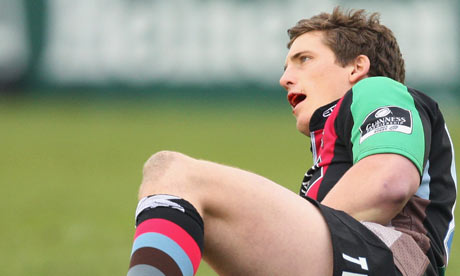
Tom Williams was offered a series of sweeteners by Harlequins, including a job after he had retired from playing, in return for keeping quiet about what really happened in the fake blood incident against Leinster in last season's Heineken Cup, a disciplinary panel was told last week.
The panel was set up to hear appeals from Williams against a one-year ban handed out to him last month for faking a blood injury by using a capsule and by the tournament organisers, European Rugby Cup Ltd, into the decision of the original disciplinary panel to find misconduct charges against the Quins director of rugby, Dean Richards, and the club's physiotherapist, Steph Brennan, not proven.
The appeal panel reduced Williams's ban to four months after he, in his own words, decided to "come clean" while Richards was suspended for three years and Brennan for two.
The panel's full judgment was released today. In it, Williams says he went along with the cover-up originally because he had been advised by the club and had not taken independent legal advice, and was told it was Harlequins who would face any punishment, not individuals.
When he received a year's ban, he had a meeting with the Professional Rugby Players' Association and took legal advice. He decided to abandon the pretence that he had suffered a blood injury, but before the appeal hearing, he met the Quins chief executive, Mark Evans, and, later, the club's chairman, Charles Jillings.
"I met Mark on 31 July in Cafe Nero in Twickenham along with Damian Hopley, the PRA chief executive," said Williams in his evidence to the appeal. "He was friendly but outlined the consequences of my appealing on a full disclosure basis. He told me this route could involve the club being expelled from the Heineken Cup, losing sponsors and that Steph Brennan and Wendy Chapman [the club doctor] could be struck off for life and sue the club. He said it would be worse than relegation; I assume he was speaking in the financial sense.
"His suggestion was contrary to my own feelings and advice. I had a dilemma and it weighed heavily on my mind. I had no desire to harm the club, but at the same time I wanted the truth to be told. I had lied so far on the club's directions and this had resulted in a 12-month ban. I decided I would not allow the club to make me lie again.
"On 5 August, Damian Hopley and I met Charles Jillings, the club's chairman, at the PRA offices; my solicitor, Owen Eastwood, joined us later. Charles started by apologising to me for the position I had been placed in. He then laid out a compensation offer to me. This consisted of payment of my salary while I was suspended, an assurance that I would be selected for the team on merit once my suspension ended, a two-year contract extension, a testimonial, a three-year employment opportunity with the club after I had retired from playing and an assurance that he would take a direct interest in my post-rugby career.
"He asked me what I was planning to do in relation to an appeal. Damian Hopley replied that I was appealing on a full disclosure basis. Charles told me he thought I should appeal, but that it should be on a limited basis focusing on the sanction and not the findings of fact. He told me that the appeal could be dealt with in writing without a personal hearing. I agreed to consider what he had said."
Eastwood then told Williams the outcome of a meeting he had had that morning with Evans, who reacted to being told the player intended making a full disclosure appeal by saying it was a mistake that would hit the club hard financially to the extent that it would lose sponsorship, see its playing budget reduced by £2m, the bank seeking repayment of loans, redundancies and probable relegation.
"I understand that Mark said this would be my responsibility," said Williams, who that afternoon met a number of the club's senior players who said the team was behind him, and he then lodged his appeal.
Williams said that by 7 August he felt he was under severe pressure from the club not to appeal on a full disclosure basis and that his agent had called to say he thought it was a mistake to go down that route. "I began to waver," Williams told the panel, who the following day instructed his solicitor to respond to the club's offer and to propose what he felt was adequate compensation for its breach of his employment contract and the reputation damage and emotional injury caused to him.
He deemed adequate compensation to be an apology, an extended contract on improved terms and the paying off of his mortgage. Quins rejected that package but made Williams an alternative offer which he accepted: it included an apology, a new four-year contract and extra holidays. The club said it was not conditional on Williams refraining from making a full disclosure appeal.
That evening, Williams met some of the club's top officials, some of whom said it would do him no harm to appeal on a limited basis. "They were unable to convince me and the meeting ended on that basis," he added. The following day, Jillings rang Williams to say Richards had resigned and that the club would support him in disclosing everything.
Harlequins said this evening that Jillings and Evans would not be commenting on the revelations made in the judgement. Hopley said Williams's version of events in the meetings with Evans and Jillings coincided with his own but that he did not believe Quins were trying to bribe the player. "I think they were trying to compensate him for the considerable embarrassment, damage to his reputation and the lengthy ban he had received because of something that had not been instigated by him."
