
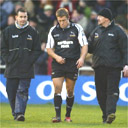
The news all England has privately been dreading finally arrived yesterday. Jonny Wilkinson, less a fly-half these days than a national treasure, is to undergo an operation next week to repair nerve damage in his right shoulder and will be missing from the entire Six Nations Championship, if not longer.
Wilkinson's club Newcastle announced last night that the 24-year-old would go under the knife on Wednesday and would be out for six to eight weeks while he recuperates.
Given the concern over his physical well-being since his extra-time drop-goal won the World Cup against Australia in November, however, it is by no means certain that he will be fully fit even in time for England's tour to New Zealand and Australia in June.
Neither Newcastle nor England will contemplate rushing Wilkinson back until they are absolutely certain the surgery has been successful. In itself the decision to operate, taken following specialist advice yesterday, is an admission that the player has a more serious problem than initially feared, with senior medical advisers to the Rugby Football Union previously adamant that major surgery of this type was a last resort.
In the end, though, there was clearly no real choice. Strength tests on his upper body were supposed to have shown a gradual improvement over the past week but, to Wilkinson's obvious frustration, there has been none. A week before the Six Nations kicks off, the career of the most committed sportsman in British sport has gone into mothballs.
The flippant thought occurs that Wilkinson will probably still be practising his goalkicking in the hospital corridor when the nurses' backs are turned but, otherwise, the seriousness of his situation is obvious. If anyone has the determination to battle back to fitness, it is this most single-minded of patients but nerves are different from bones and his chosen profession is no place for the delicate.
In some ways, however, this should be seen as a welcome development. Everyone who has watched Wilkinson being led groggily off pitches around the world knows the punishment he has taken since his England debut in 1998 and, as one perceptive sportswriter put it last year, Wilkinson has effectively donated his body to England while he is still alive.
There has never been a Test fly-half with such a voracious appetite for tackling, which partly explains why he finds himself in his current predicament. All those big hits down the years have, so it seems, finally taken their toll on the perpetrator as well as his victims. Anything, therefore, which could potentially extend his career in the long run has to be a good thing.
Sir Clive Woodward's first concern, naturally, will be for the player before he even thinks about the possible knock-on effects for the England team. He had already resigned himself to being without his king-pin for the opening two Six Nations games in Rome and Edinburgh and there are several potential replacements, fitness permitting.
Assuming his own knee holds together long enough, Sale's Charlie Hodgson, for example, is a vastly talented footballer and goalkicker whose vision may even be superior to Wilkinson's. Bath's Olly Barkley, just 22, is already knocking hard on the door, and Wasps' Alex King and Northampton's Paul Grayson know their way round an international rugby field. There is also Bath's Mike Catt but he, too, is spending more time off the pitch than on these days.
Any of the above could certainly hold the fort and, in terms of England's medium-term planning, Wilkinson's loss will become a seismic issue only if his absence extends into the summer. The burning question then will be whether Wilkinson can ever be the same player he was, mentally as well as physically.
If by some cruel twist of fate he never fully recovers, Wilkinson's status as one of rugby's all-time greats is, at least, already assured. That may sound a preposterous statement to make about such a relatively young player but it is true nevertheless. In his 52 matches for England he has already scored an astounding 817 points at a Bradman-esque strike-rate, and the drop-goal which earned England the Webb Ellis Cup has guaranteed him immortality.
Since the World Cup, however, he has played only 53 minutes for Newcastle against Northampton at the end of December before being led off following a heavy tackle. Not unlike David Beckham's infamous metatarsal, daily bulletins have followed, most of them determinedly upbeat. Even after the car crash in which he was involved at 90mph on the A1 before Christmas he thanked the driver for controlling the car well. Positive thinking is one of Wilkinson's characteristic traits, which, at present, is just as well.
At a time when English rugby is looking to capitalise on the tidal wave of interest generated by the World Cup, it is equally grim news for the marketeers. All concerned can only hope this depressing tale of compacted nerve endings ultimately has a happy ending.
