
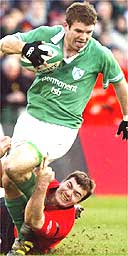
Gordon D'Arcy took the ball at one angle, darted right to give himself another and then side-stepped left, back to his original tack. All in a flash. Martyn Williams, his marker, fell on his rear. His own, that is. The Wales openside was not quite as helpless as Rima Wakarua of Italy, who, when left facing Jason Robinson of England in a one-on-one, missed him by a yard.
Williams made contact, but only by lifting his right leg and tripping D'Arcy. It is a sweet compliment to pay, an acknowledgement that you have been so comprehensively skinned that all you can do to your tormentor is commit one of the no-nos of the game.
It was not a great moment for Williams, and his day was only going to get worse. He is one of the best forwards in the world going forward, a gifted link between pack and three-quarters, but life in the back row is never a bundle of fun if the front five are struggling and you are all going the other way.
Williams had nothing to feed on from set piece - or in open play, for that matter - and found himself, instead, trying to plug a large hole between the struggling forwards and stretched backs, with not only Gordon D'Arcy but also Brian O'Driscoll coming his way. The apostrophe boys, apostolic in their launch of a new style of Irish attack, made it a day for the Wales captain and his team to forget.
Throw in another Irish, in the middle of Paul O'Connell, who embodies an ever so slightly more earthy, earthly style in the second row, and it is safe to announce that Ireland are back, possessively, in the Six Nations.
Without wishing to be disrespectful about the most deliciously aggressive beast in the Ireland pack, O'Connell is nothing new. Flame-haired ogres come out of Munster like methane out of a bog: with regularity and a whiff of menace.
But D'Arcy and O'Driscoll are fresh. They are sweeter and a whole lot saucier. There is little about O'Driscoll that has not been seen before. Wales would have prepared for his slanting runs and his explosive pace. But even after an absence of six weeks, thanks to his hamstring injury, O'Driscoll still proved too much. And he didn't just out-jink and out-run Wales, he more than played his part in the overall process of out-muscling them. His first try in Ireland's 36-15 win was born of power and determination.
The former Ireland partnership, the one that went into the grand-slam showdown with England last year, of Kevin Maggs and O'Driscoll was of classical design. There was Maggs, the bruiser, the old kerb-layer from Bristol city and still the straight-line no-nonsense centre of Bath club, doing the boshing and the bashing. Then there was O'Driscoll, mercurial, flowing, obtusely angled or curvingly graceful. Inside and outside centres, along ancient lines.
O'Driscoll is still there, but Maggs has dropped to the bench. And D'Arcy has come in from the wings. Or the wing, where he has played most of his rugby for Leinster. His entry in the Heineken guide places him as wing/full-back for his province, but here he is as the surprise midfielder for Ireland.
D'Arcy has just turned 24, while O'Driscoll recently went up one to 25. The one is world famous in rugby, the other only just out of life as Gordon O'Who? But little Gordon's feet seem even quicker than big Brian's, which is about as high as praise can go. D'Arcy also has a vision that you do not often find in a converted wing.
His pass out of the tackle in Paris, which gave Tyrone Howe his try, showed clarity of thought in tight space. Denis Hickie, side-lined with a rolled-up Achilles, had it too: it must be a speciality of Donnybrook. D'Arcy can run, dance and think.
When you put D'A's attributes alongside O'D's, suddenly Ireland have a lot of pace and elusiveness and lucidity in the very place where it appeared only three weeks ago, in Paris, that they might struggle on all three counts. Ireland: good pack, no pace, we thought. Now it's Ireland: good pack and dangerous behind.
They are, however, about to walk into the firestorm. Overwhelming at Lansdowne Road a Wales team prey still to uncertainty and fragility is not quite the same as travelling to Twickenham to play the grand-slam champions who clinched their title by crushing you in the closing quarter last year.
D'Arcy and O'Driscoll posed Wales all sorts of problems because they were running on to ball won at will by a rampant pack. O'Connell & Co won all the line-outs in the first half and made a mess of the Wales scrum in the second. The Wales defence in midfield was stretched from the word go, and nobody at the moment can take advantage of such a situation better than the Ireland centres.
But England's defence is rarely discomfited. It stretches one way and then the other and does not lose its spring or its shape. Besides, England's forwards are not going to allow their line-out to be dismantled or their scrummage turned and driven. The Ireland driving maul - their runaway truck against Wales - will find the world champions more efficient in mounting resistance.
D'Arcy and O'Driscoll will be up against an England midfield that has been around the block a few times. There may be no Jonny Wilkinson to toss runners into the air but Grayson, Greenwood and Robinson have hardly been a flood-gate when it comes to the try-count against England. In short, this is going to be different for Ireland and their new midfield.
If only because it is by now not so very new. The images of the Irish centres will have passed so many times over the tape-head that they will be playing in sepia to greedy English eyes. This is rugby with no secrets, suffocation by analysis. The tapes tell tales and England will be prepared.
But, hell, this is still all about romance. Before the Six Nations began, I had Ireland down to lose to Wales and then to beat England at Twickenham. The first I could explain rationally and the second was based entirely on the antithesis of analysis.
Since logic was blasted out of the water by D'A, O'D and O'C last week, I am prepared to stand by the prediction of a freak result at Twickenham. You have to be constant, especially when it comes to the breakdown of rhyme and reason. I haven't a clue how it is going to happen, but there will be an apostrophe in there somewhere.
You've read the piece, now have your say. Email your comments, be as frank as you like, we can take it, to sport.editor@guardianunlimited.co.uk, or mail the Observer direct at sport@observer.co.uk
