
The 10th anniversary of Italy's arrival in the Six Nations is an obvious time for reflection. One away win in a decade, two tries last season and four wooden spoons in the last five years scarcely make for a glittering roll of honour. The Azzurri's development as a rugby force is still best described as a work in progress.
No one, on the other hand, would argue the tournament has been poorer for their presence. On occasions they have been a decent set of half-backs away from troubling the best. Four victories over Scotland and a couple over Wales have rewarded the pioneers who pushed so hard for their admission. The question is not so much whether they have been sufficiently competitive, as what happens next.
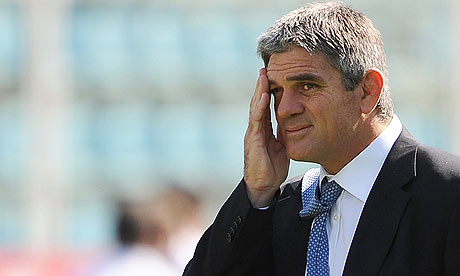
Italy's South African coach, Nick Mallett, acknowledges as much. "Italian rugby still has a long way to go before it can confidently say: 'We'll have a team of the same quality even if we have three or four injuries.' If there was another coach he'd pick the same 30 players in the squad. It's almost like coaching a club side. You have to get every individual within your team to improve. In the long term we also have to start producing players from within the system. You can't keep looking to Australia or South Africa for guys with an Italian passport."
The absence of the injured No8 and captain, Sergio Parisse, for the entire tournament will not make life easier this time around but there are reasons to be cheerful. The autumn visit of New Zealand to Milan attracted a crowd in excess of 80,000 and there is increasing evidence that rugby is establishing a foothold in the hearts of football-mad Italians.
"When you get 80,000 people coming to watch us in the San Siro after 12 consecutive losses it's quite extraordinary," Mallett says. "It's without precedent in sport in Italy. The only answer I could give is that the public are far more intelligent than the press give them credit for. They're very proud of the way the players are performing. When they see the Italian team playing with such passion and commitment, it gives them a lot of pride."
Mallett believes the culture of rugby has something to do with it. "There's a feeling in Italy that rugby is an unselfish sport combining huge courage, dignity and gentlemanly conduct, not least between supporters. Unlike soccer you can bring your family and have a meal with opposition supporters … for 80,000 people at the San Siro there were three police wagons. When Bari play Napoli there are probably more policemen than spectators."
The bottom line, though, is that Italy need a reliable goal-kicker and shrewd playmakers at scrum‑half and fly‑half. Mallett, after last year's fiasco at Twickenham, when he fielded the openside flanker Mauro Bergamasco at scrum‑half, has high hopes for Tito Tebaldi, a 22-year-old from Parma, inside a former Australia rugby league international, Craig Gower.
It would also help if two Italian sides could gain admittance to the Magners League; negotiations between the Italian union and the league board, however, seem to have broken down irrevocably, with financial issues largely to blame. Next season's proposed expansion may not happen until 2012, if at all. "From a playing point of view, it's very important," stresses Mallett. "The younger Italian players look at it as a real opportunity to improve."
In the meantime, under the hooker Leonardo Ghiraldini, the aim is to improve on the recent record of one win in 10 Six Nations games. "We want to be competitive in every game and win at least one match," says Ghiraldini.
Mallett is adopting a slightly broader view. "I'm probably the only Six Nations coach who's not judged purely on results," he says. "I'm judged more on the way the team performs. You can't just go on the fact we haven't had many wins. If Italy adopted that attitude they would have been trying to get out of the Six Nations a long time ago and refusing to go on summer tours. I've never felt the team has lost heart. I can see them improving all the time."
