
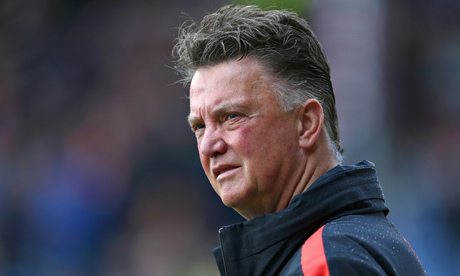
Louis van Gaal has spent more than £100m on just four players since arriving in England, smashing the British transfer record and ignoring any lingering suggestion from Sir Alex Ferguson that a Manchester United manager had a duty to look for value in the market, yet still he is not satisfied.
He complained at the beginning of the season that he had inherited an unbalanced squad, with “too many No10s and no defenders”, and though he is happy with his new acquisitions he is not yet convinced that equilibrium has been restored. “We have more balance now, but I still think the squad is not balanced enough,” he said before Sunday’s home game against Queens Park Rangers. Asked which area of the squad still needed strengthening he replied: “Obviously I think the defending part.”
With injuries to Phil Jones and Chris Smalling meaning Tyler Blackett might get another outing against QPR, it is easy to see why Van Gaal is concerned about the back line. Yet in Marcos Rojo he has an accomplished left-sided defender just back from a World Cup final, while Daley Blind, who impressed as a wing-back with Holland in Brazil, can also play as a centre-half if necessary.
With Luke Shaw set to make his home debut, even if he is not yet ready for a full 90 minutes, Van Gaal is not exactly short of defenders. He just has slightly fewer options at the back than he does at the front, which is hardly surprising when United have such an embarrassment of attacking riches – even after letting Danny Welbeck and Javier Hernández go – that supporters have spent the past week trying to guess how everyone can be shoehorned in.
The likelihood is that someone quite expensive is going to have to be left out, and at this early stage the fingers are pointing at Juan Mata and Marouane Fellaini, both David Moyes signings who have yet to look fully at home. It is only natural to assume a new manager will, initially at least, prefer the players he himself has brought in, but even that raises the question of whether Radamel Falcao will join the front two to make a front three, or whether Wayne Rooney or Robin van Persie will have to make way.
At the pre-match press conference, notionally an opportunity for such questions to be raised, Van Gaal was giving little away. Is Falcao fit enough to make his debut? “I won’t answer questions about individual players.” How do you plan to use him? “That will be our surprise.” Will you have to rotate the team to keep everyone happy? “I don’t think I shall do that.” Is it a problem having to leave out good players? “No, for a coach it is always easy. At least for a coach able to make decisions based upon what he has observed. I have no worries about my ability to do that.”
Van Gaal is far from evasive, however – the only thing he has to hide is his teamsheet and perhaps his formation. Ask the right question and you get a straight answer. Do United need to speed up their game and pass the ball a little more crisply? Yes, they certainly do. “We have to pass much quicker,” Van Gaal said. “We have been trying to do that already on the training pitch. It is also true that we are losing the ball too much, too early. Maybe the reason is because I am demanding much faster play. It might be a vicious circle. The pressure is much higher on the players to act quickly and they end up losing the ball.”
Few other managers would have volunteered the information either that they still had doubts about the defence – it was certainly always Ferguson’s inclination to keep such reservations in-house – and even fewer, given the opportunity to wax lyrical about the attacking potency now available at Old Trafford, would have come up with anything like the response Van Gaal produced.
Taking on board the direction not to discuss individuals, one reporter asked Van Gaal whether the addition of Falcao to the frontline now meant United had the best strike force in the Premier League. “Excuse me but that is another question about an individual,” Van Gaal objected. “Even what you call a strike force is a group of individuals, no? I think you can assume I saw something I like in Falcao, that’s why I bought him. And the other day at the stadium I presented him, along with Daley Blind. That’s when I say something about his qualities, or Daley’s. You need the arguments about why I buy players, that is logical.
“But after that it is over. It doesn’t matter what I say now about Falcao, or Rooney or Van Persie for that matter. They are all great players, with great records, but they have to do it in the game on Sunday. They have to show their worth on the pitch. Not just the strikers but all the Manchester United players have to show themselves, in a team. It is up to them now. That is why I cannot speak individually.”
So there you have it. Van Gaal is going to put a team on the pitch against QPR and observe them. If players do well he will keep them in the side, if they struggle he will replace them. Not so different to any other manager in the league really, except that some of the casualties at United will be players with big price tags or big reputations and some might be only recently acquired.
Ed Woodward, the club’s chief executive, has just said he is looking for a top three finish, and Van Gaal has accepted the challenge. There are no European distractions to strain resources, the challenge is simply to forget the past and forge a new United in time for the end of season prizes. Transition seasons are for wimps. Van Gaal does not strike anyone as one of those.
