
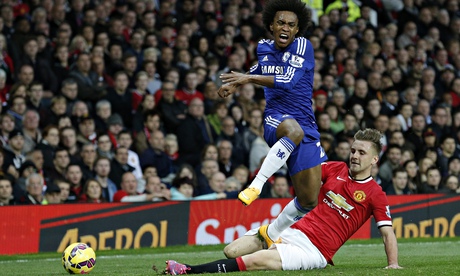
Chelsea may have been tagged the New Invincibles as they rampaged through the start of the season but Manchester United managed to slow their progress on Sunday and United’s approach has provided the Premier League with a blueprint of how to thwart José Mourinho’s big-name players.
Man-mark the midfield
While the deep-lying midfielder Daley Blind naturally tracked Chelsea’s playmaker Oscar, it was interesting to see Juan Mata and Marouane Fellaini given strict instructions to track Cesc Fàbregas and Nemanja Matic across the pitch. Mourinho’s previous Chelsea side boasted tremendous power in midfield, but this time round there is unquestionably more technical quality, which means opponents must stop the midfielders from enjoying time on the ball.
Fàbregas’ performance was his quietest in a Chelsea shirt as he struggled to find space in advanced positions, but it was particularly interesting United paid such close attention to Matic. The defensive midfielder is Chelsea’s most physically intimidating midfielder but he is also effective at starting passing moves from deep. Not only was he marked closely by a United midfielder but Robin van Persie also spent the first half positioning himself close to the Serb, denying him opportunities to receive the ball from Chelsea’s centre-backs.
Oscar pressed United well, but rarely found space in midfield. The only player given time on the ball was the centre-back Gary Cahill which, from United’s perspective, was preferable to Matic, Fàbregas or Oscar finding space.
Push the full-backs forward
Chelsea’s right-sided midfielder Willian took up some very narrow, deep positions throughout the game, offering short-passing options for his centre-backs rather than seeking to spin in behind and receive long balls. As a result it presented the Manchester United left-back Luke Shaw with a problem – should he stay in position alongside his centre-backs, or stick tightly to Willian?
Van Gaal had evidently urged him to stick tight, because Shaw was never more than five metres from Willian, sometimes advancing ahead of his midfielders to track the Brazilian. This epitomised the bravery of United’s full-backs – with and without the ball – and their aggressiveness pushed back Chelsea’s wide players.
On the opposite flank Rafael da Silva’s unnecessary early caution for a foul on Eden Hazard was extremely worrying – but while other full-backs would keep their position and ensure they did not find themselves on the wrong side of the opposition’s danger-man, Da Silva continued to push forward. Hazard was forced back into his own half – and his final act was being cautioned for a foul on Da Silva, summing up the role-reversal.
Counterattack quickly through midfield
Chelsea pressed high up the pitch when David de Gea was beginning short-passing moves from the back. Oscar pushed forward to join Didier Drogba, with the duo pressuring Chris Smalling, Blind and Marcos Rojo in advanced positions.
Usually teams stay compact and therefore the entire side push high up the pitch but Chelsea’s centre-back pairing of John Terry and Cahill are uncomfortable near the halfway line, and remained in relatively deep positions. Therefore, when United bypassed the initial press, they had oceans of space to break into, and quickly turned defence into attack, powering through the centre and finding Van Persie quickly.
United’s best chance of the first half – when Van Persie forced Thibaut Courtois into a fine save – came from the most basic move imaginable. De Gea kicked long to Van Persie, who controlled the ball, played in Adnan Januzaj, and sprinted on to the return ball. It had progressed from De Gea inside his own area to Van Persie in the opposite penalty area in just two passes.
Keep a high defensive line
Didier Drogba demonstrated he remains a tremendous aerial force with his superb headed goal, but the 36-year-old lacks the pace which provided such a threat in his first Chelsea spell. Therefore, in open play, Manchester United’s centre-backs Smalling and Rojo were happy to push up the pitch, forcing the Ivorian away from the opposition penalty box. Drogba received long passes and brought midfielders into play, but he was not capable of running beyond the opposition himself.
This, however, is something future opponents might not be able to replicate as Diego Costa’s injury absence was a significant factor in this tactic. He is essentially a combination of Mourinho’s other two options: Drogba is his aerial target, Loïc Rémy (also unavailable through injury) provides the pace, but Costa can play in either manner, which makes him more difficult to defend against.
