
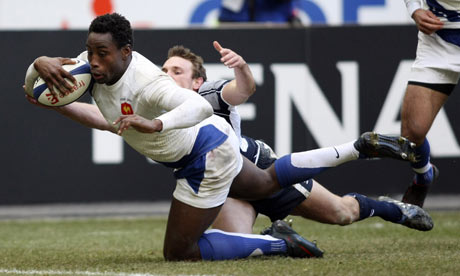
Another disappointing Six Nations for Scotland, then. And jarringly, we've only played two rounds. It had looked here as if they might redeem themselves after their flop last week, when with little more than 10 minutes to go, they brought themselves to within six points with a well-crafted try, Thom Evans taking Phil Godman's inside ball to streak over. They had deserved it, the pacy rugby they had tried to implement from the off finally starting to highlight chinks around the fringes of the French defence. It looked then as if the hosts might be tiring.
But while they had probed and tested France throughout they had never quite convinced, and the final 10 minutes they produced were a disappointment. The superior muscularity of the home team kept them penned in their own half and indeed forced the late penalty that finished any lingering hopes of a dramatic finale. The final attacks tellingly came from France with a series of scrums deep in Scotland territory.
Nothing came of them, which was an improvement of sorts, considering the severe examination of Scotland's scrum, as did their close-quarter work in general. What Scotland would have given for Euan Murray and Nathan Hines to be fit. For a scrum to have tested New Zealand and South Africa in the autumn as Scotland's did, then to be humiliated as they were here speaks volumes for the men missing, if nothing else.
Indeed, when Jim Hamilton, the only lock in their 22, left the field in the 19th minute, Scotland had to field two back-row forwards in the engine room. And judging by the improvement in the scrum when Moray Low, the only tighthead in the 22, came on in the second half, the notion of starting with two looseheads was not a wise one either.
So questions will continue to be asked of Frank Hadden, as he searches for that defining win – and that, sadly, means one that is not a rearguard action at Murrayfield against more fancied opponents. Here was another valiant attempt, and that it was off-target will be made no easier to accept by the fact that France's solitary try should not have been allowed to stand.
Actually, it should not have come about in the first place, the prelude featuring a farcical spot of pinball as a series of fly-hacks ricocheted back and forth between Frenchman and Scot alike. The ball ended up in Lionel Nallet's hands and he released Maxime Medard. Medard's angled run to within five yards of the Scottish line was clearly helped along by Fulgence Ouedraogo's blocking run, not to mention that of the referee, George Clancy, and when a Scot was finally allowed to get at Medard, his try-scoring pass to Ouedraogo appeared to have been played forward. Clancy hesitated – he was surely about to disallow the try – then as the roars of the stadium took hold, he meekly gave in and signalled the try. He is a referee who carries barely a hint of any authority.
That blow, eight minutes into the second half, opened up a 13-3 lead for France, which had been stretched to 19-6 by the time the hour was up, and Scotland had it all to do. But Scotland by then were finding holes round the outside of ruck and maul. They had played with ambition from the start, with a chip and chase from Max Evans forcing a five-metre scrum early on in the match. The ease with which the French pack saw off that particular threat was the first sign of the disparity in physicality between the two sides, and in the first half in particular, Scotland's contact skills let them down, spilling the ball again and again in the tackle. France, too, put the ball to ground on countless occasions in an increasingly disjointed and forgettable first half, but that was more to do with the fact they were playing almost as poorly as the visitors.
Yet when the sides began to tire as the second half wore on, it was Scotland who thrived. Superb handling and running between Mike Blair and John Barclay just before the hour took Scotland to within yards of the French posts, the only problem being that their own team-mates had been admiring it as much as the rest of us. Barclay was isolated and four Frenchmen swarmed round him – a penalty was always going to be the likely outcome, and the chance was lost.
Strokosch was next to exploit the gaps 10 minutes later. Barclay was on hand to keep things alive, Godman broke deep into the France 22, and it was from a series of drives from that position that Godman was able to turn the ball inside for Thom Evans to score. At last we had a game on our hands, but sadly that was as exciting as it would get.
That matters were not closer owed largely to that French physicality and the reward it was granted by the Irish referee. Maybe he was trying to redress the balance after French complaints at the refereeing in Dublin last week. Here they comfortably won the penalty count, and Lionel Beauxis did not have to be that accurate with his place kicking to earn France the cushion they needed.
They were grateful for it too, because France were dismal. Physically stronger than Scotland they may be, but it has come to something when they are put to shame by Scotland's ambition.
It is not the first time it has been said, but Scotland are not so far away from being a proper threat – a coule of big, ugly ball-carrying forwards might just complete them. So that will be Murray and Hines, then, yet they're injured, and so another Six Nations has passed the Scots limply by already.
