
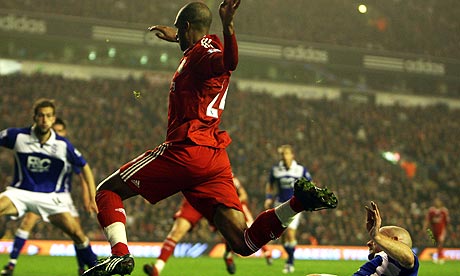
Try this for a theory. If Liverpool got lucky with their penalty equaliser against Birmingham, and they certainly seemed to benefit from one of the season's more naive refereeing decisions, then that slice of good fortune cancels out last month's miscarriage of justice when Rafa Benítez and his players were on the wrong side of a beach ball and a refereeing error at Sunderland.
The Liverpool manager suggested as much after the 2-2 draw at Anfield. "It was a pity to score with a penalty that maybe wasn't a penalty," Benítez conceded. "It is not fair sometimes but we have had a lot of things go against us this season and we deserved more from this game. We attacked and attacked, and it turned out to be positive for us."
Nice try, Rafa, but two wrongs don't make a right, luck doesn't really even itself out over the course of the season, an act of premeditated cheating is not at all the same as a genuinely freakish refereeing conundrum at the Stadium of Light, and there is no such thing as a victimless crime in a professional league competition.
While Benítez may be right in saying Liverpool deserved more from the game, as the rules stand the way to achieve that objective is to score more goals than your opponent. Legitimate ones, obviously.
That is what Birmingham had succeeded in doing before David Ngog's questionable intervention, and though the feeling at the moment may be that lowly visitors ought to be happy with a point from Anfield and Liverpool deserved something after doing most of the attacking, the perspective at the end of the season could be wholly different should a point or two make the difference between relegation and survival at St Andrew's.
This is not to have another go at referees, because most of the season so far seems to have been spent doing that and, despite what Michael Platini and his extra- pairs-of-eyes experiment would have you believe, spotting an accomplished dive in real time is never going to be easy for officials.
Neither is it an attempt to bash Benítez, who has put up with a lot of late and is entitled to express his gratitude when something happens to suggest the entire world might not be against him after all.
And nor, most categorically of all, is it an attack on a foreign player for bringing disreputable habits into the hitherto pristine world of Premier League football. Ngog is a young player who just did what most of his fellow professionals would have done in the circumstances and got away with it.
His nationality is unimportant. I mention this only because every time the subject of diving and foreign players are mentioned in the same sentence – Cristiano Ronaldo and Didier Drogba have cropped up several times in this context in the past, while Eduardo has occupied most of the column inches this season – dozens of angry bloggers always demand to know why it is only foreign players who are ever accused of diving. Are we not aware, their argument usually runs, that English heroes such as Steven Gerrard, Michael Owen and Wayne Rooney do their share of diving too?
Yes, is the short answer. Professional footballers dive, English ones among them, and while the problem may seem to have increased over the past few years along with the greater numbers of foreign players in the Premier League, the reason probably has just as much to do with the increased speed of the game and the greatly improved television coverage than with nationality.
This column is old enough to remember Francis Lee in his pomp, back in the days when the game was played on mud rather than grass and Manchester City's most famous overseas signing was still Bert Trautmann. Suffice to say that had television camera work been as impressive then as it is now, the City and Derby striker would have been in trouble with Equity as well as the Football Association.
Leaving that minefield aside, the only question to be asked is whether, with the score standing at 2-1 to Birmingham in the 70th minute of a game at Anfield, many referees would have awarded a similar penalty to the visitors. We will never know the answer, though people may have their suspicions, and that is why it is a little dangerous for Benítez to claim Liverpool deserved something from the game. Beach balls apart, the general trend is for bigger teams, especially when playing at home, to get more of the benefit of the doubt than smaller, less glamorous outfits.
That is another reason why no one is getting too worked up over Manchester United losing at Chelsea to a goal that was possibly illegal. Big teams don't deserve any additional sympathy, especially when their manager usually complains about the referee as a matter or course.
If that strikes any United fans as harsh, it should be remembered that Carlo Ancelotti has been a model of polite diplomacy all season and that last season Chelsea were the victims of the biggest miscarriage of justice of all. They should have been in the Champions League final.
It is idle to speculate now about whether Guus Hiddink's team would have beaten United – the Dutch coach lists never getting the chance as one of his greatest regrets – though looking forward it appears Ancelotti is not going to struggle as Luiz Felipe Scolari did and has the ability to bring the best from a talented group of experienced players. Those who thought Ancelotti would need time to adjust to the Premier League (guilty as charged), or had been brought in primarily as a Champions League expert (ditto), are having to think again.
Scolari stuck around until February last season so there is still time for things to go wrong, but it seems unlikely. Chelsea have opened up a five-point lead at the top of the Premier League after 12 games, will not be managed by Avram Grant should they reach a second Champions League final and will not be kept out again by an incompetent Norwegian referee. If the question of the season is why has Sir Alex Ferguson been grumpier than ever, perhaps the answer is under all our noses.
