
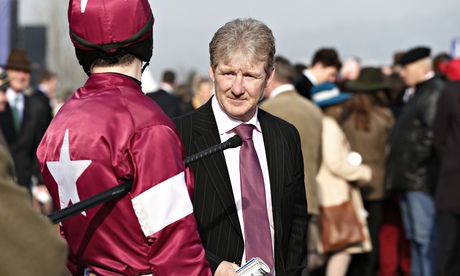
Irish racing was propelled into a doping crisis on Thursday afternoon by a verdict in a small County Tipperary courtroom, as Philip Fenton, a leading jumps trainer with multiple Grade One victories to his name, was found guilty of eight charges of possessing banned animal remedies, including anabolic steroids, at his stable in nearby Garryduff. Fenton was fined €1,000 on six of the charges, with the two remaining charges taken into consideration, and ordered to pay €4,200 in costs and expenses, a total penalty of €10,200.
Fenton said after Thursday’s verdict that he would “consider an appeal” but refused to make any further comment on the outcome. However, Chris Gordon, the head of security for the Irish Turf Club, said that the sport’s regulator in Ireland would “take the appropriate steps following the conclusion of the court case”. Gordon added: “There will be an investigation commenced immediately and an interview with Philip Fenton will form part of the investigation.”
During the trial the court had heard that investigators from Ireland’s Department of Agriculture had conducted a raid on Fenton’s stable in January 2012, finding a number of banned substances including two anabolic steroids: a 1kg tub of Nitrotain (which contains the steroid ethylestranol) and a much smaller amount of Ilium Stanabolic (which contains stanozolol). The substances were found hidden underneath a horse blanket near Fenton’s medicine store, in a cardboard box addressed to the trainer at his stable.
Caroline Garvan, a vet with the Department, told the court that the 1kg tub of Nitrotain contained enough of the steroid to provide “250 doses”.
Garvan said: “Anabolic steroids increase muscle mass, stamina and strength. They are most definitely a performance-enhancer. They increase an animal’s musculature and ability to perform. Ethylestranol is probably the most potent anabolic steroid you could see. It is four times stronger than stanozolol and you would start to see its effects in about two weeks. It is also very difficult to detect as it can be excreted out of the body in 24 hours.”
Earlier in the hearing Johnny Walshe, defending Fenton, had highlighted procedural flaws in the raid at Fenton’s yard, including a decision by Brendan Daly, one of two investigators involved, to store the box containing the banned substances at his home for six weeks afterwards rather than moving it to his head office in Dublin. Walshe also suggested that a warrant should have been served before the search as Fenton’s home was on the same property.
However, the presiding judge, Timothy Lucey, said in summary that, while some of the procedures had been “sloppy”, he was in no doubt that the substances listed in the charges and shown to the court were the same ones that had been found at Fenton’s yard and that the charges against the trainer had been proved.
The British Horseracing Authority took the unusual step of sending a dope-testing team to Fenton’s yard in February this year after news of his impending trial became public. Tests on four potential runners from the stable at the following month’s Cheltenham Festival all proved negative.
Irish racing is now left to consider the implications of the verdict, which confirms that powerful, performance-enhancing drugs were present at the yard of one of the country’s leading trainers. Fenton has enjoyed success at the Cheltenham Festival with the Bumper winner Dunguib, and took the Hennessy Gold Cup at Leopardstown in February with Last Instalment. The horse was subsequently retired after falling in the Cheltenham Gold Cup.
Nitrotain, which can be bought online and applied as an oral paste, is particularly dangerous to racing’s integrity because it leaves a horse’s system so rapidly. The bulked-up muscle growth it promotes remains, however, giving an unscrupulous trainer an opportunity to improve performance with little chance of their cheating being discovered in a post-race dope test.
