
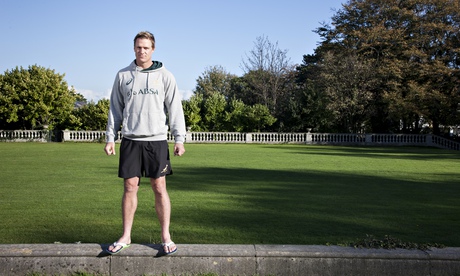
Jean de Villiers might be the most engaging captain in international rugby but, when the moment comes, he actually frowns and shakes his head. I have just asked him if leading South Africa to victory over New Zealand in Johannesburg last month, which ended an unbeaten record the All Blacks had cherished for almost two years, represented his sweetest win over the Springboks’ fiercest rivals.
“No,” De Villiers says with a shrug after a relaxed hour in which he has answered every question in intricate detail. “Not really. It doesn’t even make the top three.”
His response seems surprising because the reaction of Heyneke Meyer, the Springboks coach, had been very different. After an initially dominant South Africa needed a last-minute penalty to win 27-25, Meyer gave into ecstatic leaping around.
“It was good for him to experience his first win over the All Blacks as coach,” De Villiers says with a grin. “It was my first as captain but, you know, I’ve done it before. I’ve experienced victory over them a few times and because we started the game so well I was disappointed we let them back in. They played really well in the second half but we’re chasing the perfect game.”
De Villiers’ “few times” on the right side of a result against New Zealand amounts to nine wins compared to 12 defeats. It is a relatively impressive statistic if considered purely from the perspective of South Africa’s next opponents, England, who lost their fifth successive game against New Zealand on Saturday. England have played 40 Tests against the All Blacks and won only seven times – two fewer than De Villiers has managed in a Springbok jersey. Since lifting the World Cup in 2003, England’s record against New Zealand is played 15, lost 14.
But South Africa remain an inconsistent and still developing team – as indicated by their disappointing 29-15 loss in Dublin over the weekend. Ireland made the Springboks look both laboured and callow and De Villiers sounds frustrated. “You would think we could hang on to the ball for more than two phases. It’s a step back and well below the standard we’ve set ourselves.”
However, their compelling performance last month means De Villiers’ current win percentage against the world champions is 39%. “In the last couple of years we hadn’t managed to beat them but, prior to that, I was at about 50% against New Zealand. At one stage it was even more than that. But for our younger guys to experience that first win was good because it gives them belief we can beat anyone.”
The sheer panache of that first half in Johannesburg, when the Springboks scored three tries, was striking. Victor Matfield, Schalk Burger and De Villiers have all featured in World Cup-winning squads but the grizzled Springboks have been given fresh impetus by young players of flair and imagination.
“We played with a lot of freedom,” the centre says. “We really want to express ourselves but credit should be given to New Zealand. They’re an exciting side but they also never give up. To beat them you need to play really well. They have hardly any weaknesses so it’s vital you make the most of every opportunity because the All Blacks always pressure you. How you handle that will decide if you can beat them.”
The relationship between the two teams appears to have grown stronger under De Villiers’ expansive leadership. “We really play hard and try to rip each other’s heads off but when we come off the field there is massive respect. We have this bond. I’ve got it with Richie McCaw and Conrad Smith because you play against each so often. Ma’a Nonu is the same. After my 100th Test [when the Springboks lost narrowly in Wellington in August] I walked off the field and discovered what he’d done for me. Ma’a got injured but before he went to hospital he took off his jersey and left it in my place in the changing room.”
Nonu had just broken an arm – and so it underpins the depth of his respect that he offered that tribute to De Villiers before being whisked away in an ambulance. “It’s a fantastic sign of where we’re at,” De Villiers says.
His centenary of caps, as De Villiers became only the fifth Springbok to reach the milestone, seemed incredible when he remembered the traumatic start to his international career. “I thought back to those dark days. I was just 21 when I got my first cap in Marseille [12 years ago this week]. As a kid in South Africa you don’t say, ‘I want to win the World Cup’. You say: ‘I want to play for the Springboks – at least once.’ So I’d dreamed about that day for years.
“Unfortunately it turned dark seven minutes into the game. I tore my knee ligaments. The funny thing is I did not touch the ball once. In my first involvement in the game I tackled the guy, got up and my foot stuck. Another guy cleaned me out, my knee twisted and, as soon as it happened, I knew it was serious. I was out for nine months.”
De Villiers’ life darkened still further after his comeback. “I had just got back when I played the Springboks’ last warm-up game before the 2003 World Cup. Against the Falcons [a provincial team] I came on as a sub, played 15 minutes and scored a try. I then got tackled, a guy fell on top of me and the bone went through the muscle and my shoulder was badly damaged. I was out this time for eight months. I thought I’d never get my second cap. I spoke to the surgeon a couple of years later and he said it was the kind of injury when someone falls off a motorbike. It was pretty bad. But I trusted everyone involved with my rehab and got back.”
Even the supposed peak of De Villiers’ career, when South Africa won the 2007 World Cup, was ruined after he was again injured badly in the opening pool game. He remained in France with a triumphant squad and received a winner’s medal but he admits that: “It was a very empty feeling. I’m fortunate to have a World Cup winners’ medal but I don’t think I deserved it. I was very happy for the team and my friends but I was empty inside. I never look at the medal now.
“I’ve been selected for three World Cups and only played a combined 160 minutes of rugby in the tournament. Even in 2011, I was 25 minutes into the first game against Wales when I popped a rib. I went off and played the last pool game – from the bench against Samoa. I then started the quarter-final against Australia which we lost. So I’ve not had a lot of luck in the World Cup.”
De Villiers smiles and then makes a telling point. “I still believe if I had not gone through those injuries I would not have reached 100 Tests. I learned most of all how to overcome adversity – they were real-life lessons because I’d always played in the first team from school upwards. I’d never been dropped and had played for all my representative teams at provincial and national level. Until that first cap it was smooth sailing and I didn’t need to work too hard for anything. It means much more when you lose it for a while. If I had to do it all over again I would probably want it to be the same. I’ve loved rugby from the start and it still gives me so much joy.”
There is also exhilaration, now, in South African rugby. The Springboks’ attacking verve was captured best against New Zealand when their 20-year-old fly-half, Handré Pollard, playing only his sixth Test, scored two glittering tries. Pollard also sparked a third try, for Francois Hougaard, when he ran the ball from in front of his posts instead of kicking for touch. He was outplayed by Jonathan Sexton over the weekend but Pollard could be a star of next year’s World Cup.
“Maybe we didn’t have that ability in the past but there is now definitely flair and variation,” De Villiers says. “The next challenge is to perform like this in the northern hemisphere.”
De Villiers, who spent a happy season playing for Munster in 2009-10, is used to rugby on this side of the world. He is also determined that his team will return to form against England on Saturday – and since losing his first two Tests at Twickenham he has been undefeated in his ensuing nine matches against the World Cup hosts. “We’ve had better results lately against them but England are still looking good for next year. They’re a very strong side and under [Stuart] Lancaster they have done fantastically well. So it’s going to be a real test at Twickenham.”
As always with South Africa the most tangled test is rooted in politics. The thorny old issue of racial quotas has resurfaced with demands that, by 2019, half of all South Africa’s representative squads should consist of “non-white” players. De Villiers’ best friend, Burger, was dropped in the Rugby Championship to allow the inclusion of the young black flanker Teboho “Oupa” Mohoje amid simmering controversy.
“It was very unfair and Oupa handled it unbelievably well,” De Villiers says of a new team-mate whose nickname is Afrikaans for grandad. “The only way you can prove people wrong is by the way that you play. Oupa showed in those two games [against Australia and New Zealand] he deserved his place. He never sulked about the media comments. He’s such a happy guy, a good person, and he brings a great vibe to the team.
“But sometimes I feel … how do I put it? It doesn’t come across nicely when they say Bryan Habana has only played 104 games because he’s a quota player. He’s some quota player. The guys we’ve got deserve their place on merit. The worst thing would be if a guy is picked and you don’t feel he’s good enough. It’s not fair to him or to anyone. We’ve got a team that believes in each other. It doesn’t matter what colour their skin is … all our guys deliver. We need to make rugby a game for everyone in South Africa – but you work from the bottom up. You don’t start at the top.”
De Villiers and his wife are expecting their third child before the end of the year. He jokes: “Looking after three kids under the age of three is going to be harder than winning the World Cup. But I’ve got less than a year left playing international rugby and I want to make the most of it. Being captain is such an honour and to see the team develop has been incredible. We are growing as people and players all the time. The best of us is still to come. Hopefully we’ll get it right just in time for the World Cup.”
