
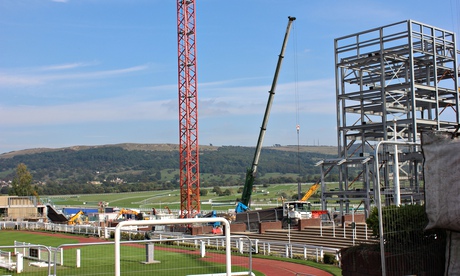
The most impressive feats at the home of jump racing this winter may not take place on the track but next to it, where a team of 200 construction workers will proceed with a £45m project between fixtures while sweeping the site clean in time for 16 racedays between now and April. The first of those is just over three weeks away, which might seem impossibly ambitious to the casual visitor, letting his gaze fall upon the many gaping holes and piles of rubble that lie between the paddock and the main grandstand.
Ian Renton, who manages the track for its owners, the Jockey Club, acknowledged the scale of the challenge after a tour of the works this week. “It feels like roughly half the site at the moment is a construction site,” he said. “Once we get down to racing itself, that will be reduced to 10% or 15% of the site. So we’ve got to bring 30% of the site back into play over the next three weeks.”
The extent of the project was revealed in March, shortly after the famous Festival, and was big news at the time but will since have slipped the minds of many jump racing fans during the off-season. Cheltenham regulars will turn up next month having forgotten that any kind of change is underway, until being reminded by the enormous red crane that now towers over the area. What reaction does Renton expect?
“I think they would be quite shocked if it was still in the state it is today in three weeks’ time but, given it’s going to look in great shape for the most part, though there will still be two or three areas under construction, I think probably one of fascination as to what is happening and how things are changing, hopefully along with excitement that what we’re doing is changing things for the better.”
Renton radiates no doubt whatever that, despite the upheaval, his course will be in a condition to welcome the normal quantity of racegoers for each fixture through the coming winter. He is reassured by the precisely detailed plans, which involve bits of the course being completed and handed back from builders to management in 11 different phases over the next 15 months. Things have gone smoothly so far; “No skeletons, no unexpected water sources,” he says.
While matters are still at an early stage and the additional grandstand is no more than a steel skeleton, Renton has also been impressed by the reliability of the construction firm which leads the project. It remains on time and on budget and three fixtures were held without disruption in April, even though demolition work proceeded at a merry pace in the intervening days.
Taking the Ascot route and closing up for the duration would certainly have simplified things but this option does not seem to have been on the cards at any stage. “It would be very difficult to run the Festival anywhere else other than Cheltenham,” Renton says. “So I think our first thought was, how we can run the Festival here while the major building operation is in progress? And then, if we can run the Festival, why can’t we run the other race-meetings as well?”
This bit of bravery means that, next month, Renton will have his course handed back to him by the builders on a Wednesday night, 36 hours before the public are expected. As he puts it: “We’ve got all day Thursday to set ourselves up for racing”. The preparation that must be squeezed into that Thursday would normally be carried out over weeks.
Some areas will still be boarded off from racegoers but the line of boards will recede from one month to the next and Renton says that each fixture this season will feature a newly improved area made available for the first time. Most notable among these will be a food and drink area called Quevega’s, named after the popular Irish hurdler, where people will be invited to sip wine and eat tapas food on a terrace looking over the paddock towards Cleeve Hill. It will have a roof and heating, because this is still a jump racing venue after all, and is planned for opening in November.
Some of the improvements will be virtuous rather than indulgent. There are now solar panels on the weighing room roof and something called a ground source heat pump will be installed. Taken together, those innovations should provide enough energy to heat one floor of the grandstand.
The new grandstand will not be fully open until 2016 and will not even have a name until some point early next year, but the ground floor area is expected to be usable for the next Festival in March, when 1,000 racegoers should be able to use it. That is already double the number of people who watched racing from the decades-old building that formerly stood on the spot.
“I think for almost every sector of our racegoers, there will be some improvements for them to see this season,” Renton says. “A lot of people like to cling to the past and any change of something that’s been there for years and years, you start with a negative, so we’ve got to make sure that everyone realises it is a significant change for the better. I’m really confident that racegoers throughout the season are going to come here and think, yeah, it’s even better than it was last season.”
Racing professionals also have to be reassured, especially jockeys, some of whom like to follow the same ritual of preparation on the same seat in each weighing room they visit. Cheltenham’s weighing room, though knocked down and rebuilt as part of the works, is substantially the same and much effort has gone into setting out the seating area exactly as before.
That effort extends to the many little cards signed by jockeys and pasted above the spot where they prepared for an especially notable ride. Even some Gold Cup runners-up, like Captain John and Cybrandian, have been commemorated in this fashion and all the cards had to go back exactly where they had been, necessitating extensive photographing of the room before work began in the spring.
The Festival’s winning-most trainer has registered his own concerns. “Nicky [Henderson] has a manhole from which he’s watched all his Cheltenham Festival winners,” Renton reports. “It’s quite close to where the new structure’s being built but it remains there for now.
“We’ve identified the manhole. We’ll have a conversation about whether he is going to take the manhole back to his stables and we replace it with a new one or whether it remains. He likes to watch a race from there. I had a conversation with him last season. He was very concerned about what was going to happen to his manhole.”
