
Amid the neatly laid-out pages of the prospectus for Presentation Brothers College, a private boys' school in Cork, a single sentence stands out, not least because it is the only one in a document covering all the school's activities, academic and otherwise, to appear in capital letters: THE COLLEGE GAME, it reads, IS RUGBY FOOTBALL.
Established in 1878 by Catholic laymen, the school has a rich rugby tradition. Tom Kiernan, who led the 1968 Lions to South Africa and coached Ireland to a triple crown, is a past pupil, along with 22 other internationals, including Ronan O'Gara, who captained the school's junior and senior teams, and his Munster half-back partner Peter Stringer. So is Declan Kidney, who returned as a teacher and rugby coach, the beginning of a career that reached a climax last year when he guided Ireland to a first grand slam since 1948.
"Rugby has always been a huge factor in the school," says Ned Van Esbeck, a historian of the game in Ireland and another former pupil. "It has produced a multitude of Irish internationals, and Declan certainly inherited the tradition."
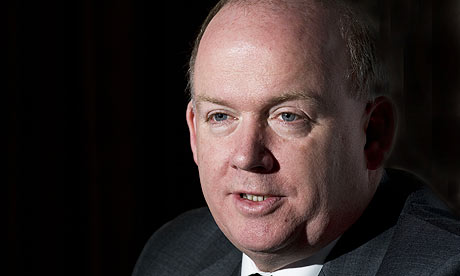
The most unassuming of figures, Kidney is a balding, smiling 50-year-old former fly-half who might easily be mistaken for the squad's kit man. Sitting next to Brian O'Driscoll at the recent launch of the 2010 Six Nations tournament, he was happy to let his charismatic captain do the talking. But whatever it is he does, it certainly seems to work. Heineken Cup victories with Munster in 2006 and 2008 followed by last winter's international clean sweep and an excellent autumn series make a solid case for his pre-eminence among European rugby coaches.
"Winning the grand slam, then beating South Africa and drawing with Australia in the autumn – it was a fantastic year for Ireland," Nick Mallett, Italy's head coach, said the other day, before going on to draw a comparison with the green-jerseyed teams that finished second in the Six Nations on five occasions between 2000 and 2008, first under Warren Gatland and then under Eddie O'Sullivan, without managing to take the final step. "It was a very different side then," Mallett added. "Probably not as happy or as well-organised. Now they seem to understand exactly where their strengths are."
Gatland, who watched Ireland score a last-minute try against his Wales team to reach the grand slam pinnacle in Cardiff last March, unhesitatingly nominates "togetherness" as the factor distinguishing the team under Kidney. "Declan's known a lot of those players for a long time," he says. "They look a happy side."
If there is a secret to Kidney's success, it may be found in a passage in his old school's prospectus describing the role of the chaplain. "Chaplaincy," it says, "is about people – not structures, programmes and tables." Substitute "coaching" for "chaplaincy" and you have a fair summary of Kidney's creed. When asked to name the influences on the way he organises a team, he mentions not other great coaches or tactical manuals but the days from his childhood when he and his father, Joe, a wing with the Dolphin club, would watch three matches every weekend.
"When I started playing, at the age of seven or eight," he says, "I'd play on Saturday morning and we'd go to watch a senior club match in the afternoon. Then there'd be a thirds match on Sunday morning and a seconds match that afternoon. It was just a way of life, really."
After leaving PBC he was soon asked back to coach the under-13s, and on graduating from University College Cork he returned to guide the senior XV to three national championships. He led Ireland's schoolboys to the triple crown and took the Under-19 side to victory in the World Cup before embarking on his first spell at Thomond Park in 1998, during which Munster reached and lost two Heineken Cup finals. After four years there he was invited to join Ireland as O'Sullivan's assistant but when the two Corkmen failed to gel, it was said that O'Sullivan had never wanted him in the first place.
In the summer of 2004, at the low point of his career, he accepted a job with Newport Gwent Dragons, on the understanding that he could commute from Ireland. Before the start of the season, however, Leinster made him an offer, and the Dragons bowed to his desire to return home. The Dublin-based team reached the Heineken Cup quarter-finals under Kidney, but at the end of the season his stint came to an early and controversial end when Munster invited him back to Cork.
Some of the Leinster players were bitterly critical of a decision shaped, he later explained, by a desire to be near his terminally ill father. But he picked up the pieces as Munster became a European force with Heineken Cup final victories over Biarritz and Toulouse. That second victory was followed by another call from the IRFU, who had terminated O'Sullivan's contract and were willing to give Kidney the extensive coaching team he required in time for the 2009 Six Nations.
"Declan's great gift is for delegation," Van Esbeck says. "He has a fantastic ability to surround himself with people he knows can do the job and in whom he has implicit faith. He inherited a lot of good players from Eddie – who won three triple crowns, don't forget – but what Declan has done is get the very best out of the talent available to him."
While his team manager, Paul McNaughton, and coaches Gert Smal (forwards), Alan Gaffney (backs) and Les Kiss (attack) get on with the close-quarters work, Kidney can stand back and apply his thoughtful, people-first approach to problems such as the ever-increasing competition for places. "If you can create the environment where the players are pushing each other along," he says, "you have to watch it carefully, because players will react differently. You don't want a fellow living in fear that if he goes out on the pitch and makes one mistake then the other guy is in. It's not fair on him to do that. We're all different, with our upside and downsides. It's about learning to respect people and what they bring.
"We're dealing with human beings, so there's no exact science to it. But there aren't many walks of life where everybody gives everything they have to what they're doing, and when you're coaching in sport, you're privileged to see people doing that. And if the players are giving everything, you have to give them a little bit in return."
It would be a misjudgment, however, to conclude that Kidney's style of man-management precludes an interest in the technical side of modern coaching. According to Mallett, Kidney's Ireland are more pragmatic than their predecessors. "They don't play it as fast and loose. They can take you through the phases. They've got very good goal-kickers, very good forwards and world-class backs." Gatland points to the accumulation of experience – "the one thing you can't coach" – which makes them "a tough side to put away".
That experience comes largely from a bunch of players in their 30s, including O'Driscoll, O'Gara, Paul O'Connell, Gordon D'Arcy, Shane Horgan, Jerry Flannery, Marcus Horan, Donncha O'Callaghan, David Wallace and John Hayes. "I think they're probably at their peak at the moment," Gatland says. "If you look at the ages of a lot of their players, they need to start thinking about the next group coming through. They'll be really good for the next 18 months, up to the World Cup, and then they'll have to start replacing them."
For Kidney, that process has already begun. In the meantime there is Italy at Croke Park tomorrow afternoon, followed by four other nations anxious to dethrone a side established as the northern hemisphere's favourites to shine in New Zealand in 2011.
"The players had disappointments in the past and come so close to it," Kidney says, "and now they've got a taste. Some of them don't have that much longer left. But they're determined to add up what's in their trophy cabinet at the end of their career rather than taking a look at it now. One thing you can guarantee is that it won't be like last year. It never is. But it can be just as much fun."
In 2009, he observes, Ireland were like the outer rings of a target. "Now," he says, "we're everybody's target. We're the bullseye."
