
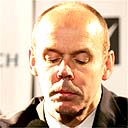
After seeing the All Blacks crush his British and Irish Lions side and inflict the most humiliating defeat of his coaching career, Sir Clive Woodward was quick to counterattack by reporting two New Zealand players for what he believes to be an illegal and dangerous tackle on Brian O'Driscoll, the Lions' captain, who was put out of the tour after suffering a dislocated shoulder inside the opening minute of the first Test.
The citing officer, Wilhelm Venter of South Africa, will have 12 hours to decide whether Tana Umaga, the All Blacks captain, and Keven Mealamu, the team's hooker, have a case to answer in front of the judicial officer, Terry Willis of Australia.
In Woodward's view, Umaga and Mealamu subjected O'Driscoll to a dangerous "spear" tackle. "There's a ruck," the head coach said, "the ball goes away, one player lifts up one leg, the other lifts up the other, they turn him over and spear him into the ground. It took half an hour to put his shoulder back in. And he was lucky. If he'd landed on his neck, it could have been a lot worse. He's extremely upset and very angry."
Not far from Woodward's side during the impromptu press conference three hours after the end of the match, was Alistair Campbell, his media advisor, who was no doubt aware that the possibility of a citing for two All Black players might deflect the hailstorm of criticism coming their way after a disastrous showing in Christchurh's Jade stadium. So ineptly did the combined British and Irish succumb to Graham Henry's resurgent All Blacks that only the most outrageous optimist would expect them to level the three-match series when the two sides meet again in Wellington next Saturday.
The early loss of their captain was a bitter blow, and O'Driscoll will play no further part in the series. Nor will Tom Shanklin, the Welsh threequarter, who was not part of today's 22 but injured a knee in training yesterday. Woodward also announced that Richard Hill, who left the field injured in the first half after making a tackle on Ali Williams, would be unavailable for the remaining matches, but a subsequent medical bulletin suggested that the flanker's problem might not be as serious as had been feared.
But none of these problems, even the departure of their captain so early in the match, could explain the poverty of the Lions' display. Even the atrocious conditions, which might have been expected to assist their territorial game, were handled better by New Zealand. One statistic above all highlighted the extent of their problems: on no fewer than 10 occasions the All Blacks stole the ball at the Lions' lineout. Shane Byrne, preferred over the more powerful Steve Thompson in the starting XV specifically for the accuracy of his lineout throwing, was withdrawn after 58 minutes.
As they were going 6-0 down to the second of two Daniel Carter penalties in the opening quarter of an hour, they were further handicapped when Paul O'Connell was sent to the sin bin for entering a ruck by the side door. But the Irish lock was back on the pitch when Ali Williams, his opposite number, took advantage of another Lions lineout disaster to catch the ball cleanly in the middle of the line and stroll the 10 yards to the tryline virtually unopposed. Another Carter penalty early in the second half reaffirmed the home side's superiority, and they completed their scoring with half an hour to play when Tana Umaga cut the Lions' defence to ribbons before hurling a long pass out wide to Sitiveni Sitivatu. The burly wing did to England's defenders what his compatriot Jonah Lomu so memorably did to their predecessors in Cape Town during the 1995 World Cup, touching down with a trail of bodies lying in his wake. Carter converted to bring the New Zealand total to 21 points. All the Lions could muster by way of a reply was Jonny Wilkinson's penalty in the 56th minute.
Next to the collapse of their much vaunted lineout, the experiment of teaming Wilkinson and Stephen Jones at inside centre and fly-half respectively was the night's biggest disappointment for Woodward. Others who conspicuously failed to live up to their reputations included Jason Robinson, Will Greenwood, Neil Back, Ben Kay and Hill, all veterans of the 2003 World Cup winning squad.
The clamour for an infusion of fresh blood - and Welsh blood in particular, from the ranks of the Grand Slam champions - will intensify in the coming days. Woodward, however, will probably feel that he did not get where he is by listening to armchair selectors, and it could take more than one defeat to persuade him to subject his expensively laid plans to a radical overhaul before the end of a series which he must now be odds-on to lose.
