
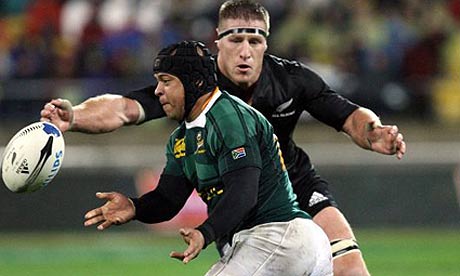
The bullet Graham Henry dodged last week now has Peter de Villiers as its target. The South Africa coach is under fire after three defeats in four Tri-Nations matches: another one tomorrow against Australia in Durban would condemn them to the wooden spoon.
It would be some comedown after last October's World Cup success and de Villiers has not perhaps helped his cause this week by blaming senior players for the Springboks' plight. He was a surprise choice to succeed Jake White, but it is not just a new coach the Boks are contending with: they are also struggling with the experimental law variations.
The ELVs were always more likely to impact more on South Africa than New Zealand or Australia because the Boks, as they showed in the World Cup, were almost European in their structured approach to the game. Set-pieces and defence were significant factors behind their success in France last year and they were undone against New Zealand in Cape Town last week by their attempt to play a wide game.
South Africa's backs did make some impression against the New Zealand defence, but their forwards struggled to get to the breakdown and conceded any number of turnovers. Richie McCaw became the game's dominant figure and if any one moment signified the impact the ELVs have made, it was the replacement of the flanker Schalk Burger on the hour.
Burger was a seminal figure under White, physically imposing and direct, but his impact is more marginal in the more expansive tactics devised by de Villiers. Butch James, the controlling influence in France, is also struggling, but that may also be a legacy of more than a year's non-stop rugby, ditto with Percy Montgomery.
Had the Boks had someone to match McCaw in the tackle area, they would probably have won last week with something to spare. They ran some intelligent lines and used the threat of Bryan Habana cleverly, but the profound change de Villiers is looking to make will take time. His problem is that the demand for results is instant and, like Henry last week, he needs any sort of victory.
Australia's Robbie Deans is also in his first year in charge but, unlike de Villiers, was not burdened by expectation. Two victories against the All Blacks and the Springboks have cemented him in the job and the Wallabies are the slight favourites to win the Tri-Nations, five points behind New Zealand, whose remaining game is in Australia, with a game in hand. The final weekend could see Deans and Henry plotting against each other with the title at stake.
South Africa's interest in the title looks academic: they need two bonus point victories over Australia in their final matches without giving anything away to overtake New Zealand, but de Villiers is looking to the longer term, as he had to with the introduction of the variations. A problem for him is that he has been inconsistent in selection - Montgomery was chosen on sentiment last week - and goodwill towards him has evaporated.
A disappointing feature of last week's match was the lack of offloading in contact. The variations were supposed to lead to more fluidity, but there is at least as much whistle as ever and teams are happy to kick the ball away knowing that turnover ball is the best to attack from.
The Air New Zealand Cup is a better advert for the ELVs than the Tri-Nations and in devising his tactics, de Villiers has bound himself by the spirit of the variations rather than the reality of them. They have not changed a huge amount: ball-in-play time was higher in most of Wales's Six Nations matches this year than it has been in the Tri series so far and the Welsh mastered the art of the kick-and-chase.
By blaming players and the referee Matt Goddard for the defeat to the All Blacks, de Villiers only heaped more pressure on himself. He has confined himself to one unforced change, Conrad Jantjes for Montgomery, but if the Springboks prevail in a match which a couple of months ago looked a home banker, it will be because the spirit of the World Cup has been recaptured rather than any affinity with the enigmatic variations.
