
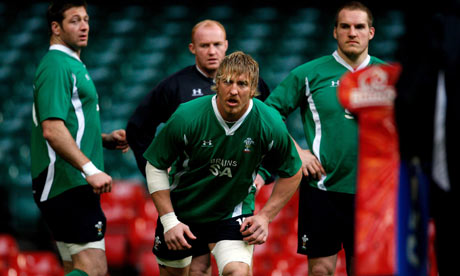
The voices of history warn us to be sceptical when Wales march into the Six Nations Championship wearing the badge of undisputed favourites, as they do this weekend. Travelling to Scotland for tomorrow's demanding opener at Murrayfield, a place where odds are often upset, they find themselves quoted at 2–1 to retain the title they won last March, at the end of a campaign that had brought them their 10th grand slam. But the men in red need only cast their eyes back three years to a time when, setting off from an identical position, they crumbled so badly that within weeks the whole of Welsh rugby seemed to have collapsed with them.
As had become a habit since the glorious 1970s, triumph went to Welsh heads. "We might have had a bit of a hangover," Robin McBryde, the hooker in the 2005 side and now coaching the current squad's pack, said this week. "We hadn't had that level of success for a number of years and perhaps we were a bit guilty of standing still and not making sure we kept moving our game forward."
They were guilty of more than that. The fall of Mike Ruddock, the man of Gwent who guided them to the 2005 triumph, exposed a viper's nest of mistrust and disloyalty. Player power, in the hands of a group of senior internationals who retained strong links to the previous regime, undermined and finally did for a head coach who had appeared to blend the stern imperatives of the modern professional game with the precious Welsh tradition of inventive heads-up rugby.
Three years later, most of those senior players will be back on the pitch to face Scotland. The mood, however, is very different in a squad now entering their second season under the leadership of Warren Gatland, their Kiwi head coach, and his principal assistants, the Englishman Shaun Edwards and the former Wales scrum-half Rob Howley. The presence of a triumvirate forged during successful seasons at Wasps ensures, as McBryde says, that "rugby decisions are being made by rugby people". Facing the familiar charge that the only thing worse for Wales than failure is success, they are now mounting an insistent campaign against complacency.
"The only thing I can do is talk about it," Gatland said before departing for Edinburgh. "We've spoken about the egos getting too big for them, about the preparation not being as good, about not challenging each other. And none of those things has happened. I haven't seen their egos getting too big. I've seen them work even harder this year than they did 12 months ago. We had a training session on Saturday that was as tough as anything they've done. Twelve months ago they wouldn't have been able to get through it. But they got through it comfortably.
"There's no secret to it. The key is to get them to challenge themselves, to be hard on themselves. It's not the external pressure that's the problem – it's the pressure you put on yourself in terms of wanting to perform. The coaches can drive a certain amount but it's got to come from within the squad. The leaders in the team have got to demand that quality – be tough on each other at training. They've responded very well to it and there have been no signs to me that we aren't going to go into this tournament prepared."
In 2005, according to Martyn Williams, the back-row forward who is due to earn his 85th cap for Wales today, there was a feeling of "Right, we've done it" among the players. "And after the last grand slam and the Lions tour, a quarter of the side were out injured with long-term serious injuries," he said. "Now everyone's fit and we've got strength in depth. That's a big difference. We had nowhere near this depth two years ago, and when we did have a few players out we struggled. This time we're being constantly reminded that we've got to kick on. We want to be a great side, not just a good side."
While defeats in November at the hands of South Africa and New Zealand reminded the players of how much work remains to be done, the subsequent victory over Australia made them the only Six Nations side to beat a southern-hemisphere team during the autumn. "It reminded us of how well we can play," Shane Williams, the International Rugby Board's world player of the year, said on Wednesday. "We were disappointed in the way we played in the first half against South Africa and in the second half against New Zealand. In the Australia game we got everything right. It reminded us that when we can play consistently well for 80 minutes, we can win a game like that."
Added impetus comes from the recent success of two regional teams, the Ospreys and the Blues, in reaching the Heineken Cup quarter-finals. The two sides contribute more than half of Gatland's squad. "The beauty of it is that they've come in as winners," said Alan Phillips, now in his seventh year as Wales's team manager. "They're pumped-up already. In the early years of professionalism, our sides weren't strong enough. Now they are."
The decisive moment in the recent history of Welsh rugby appears to have been the defeat by Fiji during the 2007 Rugby World Cup one autumn day in Nantes. Roger Lewis, the Welsh Rugby Union's new chief executive, resolved to "clean the stables" by creating a culture of honesty and integrity. The appointment of Gatland, universally admired for his achievements with Waikato, Ireland and Wasps, was the first step.
Fewer headlines were attracted by the appointment of new directors of finance, legal affairs and communications to an organisation still preoccupied with reducing the debt incurred by the building of Cardiff's Millennium Stadium (down by £10m last year, to £30m). But the 54-year‑old Lewis, a music graduate who ran Radio One, EMI Records and Classic FM before returning to Wales, sees the playing and administrative sides as requiring the same qualities and approach in a drive to end the proverbial volatility of Welsh rugby through a strategy of "long-term sustainability, on and off the field".
The results could be seen this week in the presence of bulldozers at the Vale of Glamorgan hotel, a resort complex a couple of miles off the M4, where the Wales squad's headquarters are being revamped through a large investment in an indoor centre containing sophisticated match-analysis equipment, flanked by a new indoor pitch and three outdoor playing surfaces: one all-weather, one regular, and one prepared to international standards. A new centre of excellence will be opened later this year.
"We have talent in Wales," Lewis said, "and we also have a culture that can be incredibly tough on itself. In our rugby, we've had very clear values and beliefs. They were eroded in the 80s and 90s, and to some extent in the present decade. But it's in adversity that an organisation is challenged, and we've managed to find the people to address the issues that were facing us."
Success on the field, he admitted, has come earlier than expected in what began its life as a five-year plan to secure a place among the world's top five international sides. "We haven't arrived yet. Neither the business nor the rugby team is the finished article. It's a five-year project just to get our roots bedded in."
The awareness of the need for realism in the fight against complacency has been evident all week. "Let's be honest with ourselves," Gatland said. "We performed pretty well in the autumn and we're trying to play some positive rugby but you can't say we're overwhelming favourites." His captain, Ryan Jones, was asked about the pressure of being favourites and responded: "We're just contenders." Lewis, the man in charge of a £25m annual investment in all levels of Welsh rugby, pointed out: "We need systems and structures that are robust enough to weather the storm of defeat."
Impeccable sentiments, and only when the players cross the whitewash at pitiless Murrayfield will it be clear whether a centennial repetition of the back-to-back grand slams of 1908 and 1909 is on the cards, or whether the ghosts of the past are preparing, once again, to consign the last year's applause to the file marked Premature Euphoria.
