
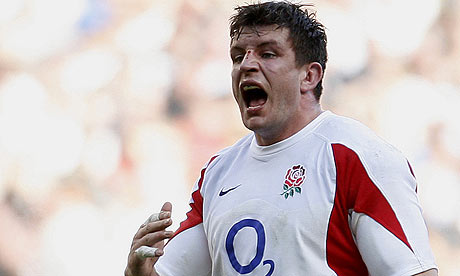
Martin Corry's face juts and bulges in all the wrong places. His brow is lumpy, his nose wonky and his cheeks pocked with old wounds and scratches. They are the scars of 13 years in professional rugby. In that time Corry has won six Premiership titles, two Heineken Cups and one EDF Energy Cup. He has been capped 64 times by England and captained them on 14 occasions. He has played in three World Cups, and six Tests on two Lions tours. And he has disjointed his elbow, torn his hamstring, ruptured his knee ligaments and dislocated his shoulder.
At 35, his body has almost given up. Tomorrow he will make his final professional appearance in England. While attention is fixed on the Lions tour, Corry will be bowing out with the Barbarians against England at Twickenham. His last match will be in Sydney, a week later. "These last two games are about all I can manage," he says, "and even then I'll have to swallow a couple of painkillers and hope I'll be OK."
The lingering injuries have limited Corry's game-time for Leicester this season and forced his old mucker and current coach Richard Cockerill into making the tough decision to leave the back-row veteran out of the squad for the Heineken Cup and the Guinness Premiership final. "He would still play twice a week if he could," Cockerill told me recently, "but his body just can't take it anymore."
"It's the unfortunate truth," agrees Corry. "I love the game and if I could keep playing I would." But he can't, so instead he is going to "step away for period of time, be it a month, six months, whatever. I want to have a look and see, experience something else away from rugby".
It seems certain, though, that he won't be gone long. "I'll definitely stay involved at Leicester, but it's a question of in what capacity," he says. "It could be an hour a week or it could end up being a full-time position. As soon as I fully retire from being a player I'm going to see things a lot clearer. For now I'm still getting up in the morning and going to training and thinking about the game. Once they take that away from me, we'll see.
"It has been a season of highs and lows and in that sense it's been symptomatic of my whole career."
A strange sentiment that, given Corry is one of the most decorated players in the history of the game. But, unlike some of his England team-mates, when he looks back at his career he does not do so with the certainty of a man who has achieved all his goals. Corry never won a Lions tour and was kept on the bench when England won the World Cup final. As had been the case for so long, he was kept out of the team by the untouchable back-row trio of Neil Back, Lawrence Dallaglio and Richard Hill.
"After the 2003 World Cup I was determined never to be a support act again," Corry says, but when his time finally came, English rugby was falling apart. Made captain by Andy Robinson in 2005, he endured the grim experience of being booed off by England supporters more than once. The sight of an exhausted Corry, face battered, shirt torn, trudging off the field after giving his all in another defeat became a familiar image. He was in the very thick of some miserable times, seemingly shouldering more than his share of the burden. Throughout, Corry played with a marvellous but futile indefatigability.
"If you're not winning for England, if you're not winning at Twickenham, you deserve all the heat you get. It's fair game," he says. "It was tough. But even when you're winning, international rugby is tough."
Corry also shrugs off the idea that he should be lauded for the effort he put in. "It should be taken as read that if you are going to play for your country you give everything you've got, because it means so much. That's the way I play my game and there's nothing more to say. It doesn't make defeat any easier, but at least you can sleep at night."
Asked just what went wrong after England triumphed in Australia Corry becomes a little incensed. "Everyone says 'England were rubbish after '03' and that our summer tour in 2004 was poor, but after that we showed signs ... We beat South Africa, we beat Australia, we should have beaten New Zealand at home in '05. It was after that the wheels came off. It wasn't as though it was all terrible. But there were times, between '05 and '07, when we went belly-up."
But why? "You know, there was no real succession plan from 2003 so we were always going to have problems. Look at England now, post-World Cup, they're having to rebuild. But they are showing signs of improvement. Hopefully, if the squad stays settled and injury free then Johnno can take them on to great things. But if he starts getting a couple of key injuries we're back to where we were before. You need to have luck and you need to have the right people in charge. For England now, we've got that."
The "right people in charge"? Were Brian Ashton and Andy Robinson the wrong men for the job? "No," says Corry, flatly. "I think you have to ask what makes a successful side? You can't just apportion blame or success to one area, you need everything to be right. With Johnno and that team, those players they had so much winning experience. With them, everything was right. But England haven't had the complete jigsaw since then, there's always been one or two pieces missing."
In 2006, when England lost five straight matches including three in a row at Twickenham, they were missing more than one or two pieces. "That run of defeats, while I never want to experience that again, we did come through it stronger," insists Corry. "Everyone thinks it must have been a living hell for me, but it wasn't, because I was always believed we would win the next week."
He learnt that attitude early on, during the frustrating years on the fringes of the England squad. Corry made his international debut in 1997, but was not a regular until after 2003.
"In the early stages that was something I struggled to deal with because I felt I was playing well enough to get in the team," he admits. "But as time went on I learnt that team selection is a subjective call. That's how you have to look at it. Just like when England were in that losing streak, I always thought about the next game. Because one day you will get that opportunity, and you have to be in the right physical and mental shape to take that advantage."
That was exactly what Corry did on the 2001 Lions tour to Australia, when he first proved himself to be a world-class player. Called up as a replacement for Back, Corry played in all three Tests. "I arrived on that tour and [Lions coach] Graham Henry came up to me and asked 'What do you need to play your best on this tour?' I said: Just an opportunity.'"
"I'd watched the Lions since I was a little kid. That's where legends are made, on Lions tours. I felt like I needed to raise my game just to feel I deserved the jersey. And on that tour I got a couple of breaks. The cards fell for me. Some times you ride your luck, others it rides you."
It's that phlegmatic approach and the commitment to carry on regardless that typifies the man. It was never more obvious than in the 2007 world Cup, the remarkable final twist in the story of those sorry years and the culmination of Corry's international career. He was the captain, standing in for the suspended Phil Vickery, when England lost 36-0 to South Africa in the pool stages.
"That was the lowest I've ever seen an England dressing room," Corry recalls with obvious pain and regret. "You make so many sacrifices to play for your country and so many more to go to a World Cup. You're at a stage where the eyes of the world are on you and you want to do yourself, your family, your country proud. But we messed up. Really messed up. It was just devastating.
"But with every trial and tribulation there is an opportunity. We told ourselves we couldn't afford another game like it. If we did, we were going home in national embarrassment. We had to find a way. We just couldn't lose another game." And they didn't, until they reached the final.
"The pressure pulled the team closer together," he says. "You get mentally tough by experiencing tough times and coming through them together. The quarter-final against Australia we won through sheer determination than anything else, just huge bloody-mindedness. But even then [Stirling] Mortlock still had a kick to take the lead in the dying seconds. We could have lost. That's the way the game goes."
Corry smiles at the idea England were no further from winning that World Cup than the mere width of the inch by which Mark Cueto's foot slid into touch as he crossed the try-line. "I don't know whether his foot was in touch or not," he says. "I still haven't seen it replayed.
"Who is to say what would have happened if we had scored? As much as you try to forget about it, in finals you do actually play the scoreboard. South Africa would have altered the way they played."
It still hurts, though, and he warms to the theme, his eyes lighting up with the memories, "The more telling call came when [Mathew] Tait made the break and Schalk Burger came diving in. He eventually got penalised for it, but had we not had that passage of play you can bet your life that Burger would have been binned for diving in from the side. Now that would have made an interesting dynamic, 10 minutes against 14 men, plus the three points for the penalty..."
"But it is all ifs and buts. South Africa were the best side in the tournament and though I hate to say it, they were the best side in that final."
It is almost as if Corry had caught himself having a guilty fantasy. He is just not the kind of player who believes in fairy tale endings, his playing experiences taught him that. He should get one when he walks out at Twickenham for the final time. Corry deserves the loudest of ovations from a crowd that saw him give the game everything he had, over and over again, in victory and defeat.
