
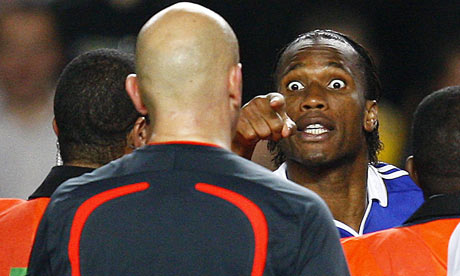
Didier Drogba will be left to sweat over potential Uefa disciplinary charges until at least the end of the season, as the European game's governing body refuses to prioritise the investigation into the Chelsea striker's behaviour, which followed last Wednesday's Champions League exit against Barcelona. A Uefa source said that Drogba might even have to wait for "five or six weeks" before he learnt of his fate.
Drogba lost his composure in the emotional aftermath of the semi-final second leg against Barcelona at Stamford Bridge – a tie the Spaniards edged on the away goals rule. The Ivorian confronted the referee Tom Henning Ovrebo, who had ignored four Chelsea penalty appeals, and he also branded the situation "a fucking disgrace" into a live television camera.
Assorted charges for Drogba have been mooted, as they have against Michael Ballack, who also chased and confronted Ovrebo, Jose Bosingwa and John Terry for comments that they made about the referee and Chelsea, as a club, for failing to control their players.
It was expected that Uefa would announce their sanctions this week but they have decided that there is no urgency about the case, as Chelsea will not play again in European competition until next season.
Their control and disciplinary panel will convene this afternoon for an extraordinary meeting in which they will rule on the Darren Fletcher controversy. The Manchester United midfielder was sent off in the second leg of his team's semi-final victory over Arsenal for a professional foul, despite replays showing that he took the ball in his challenge on Cesc Fabregas and, as it stands, Fletcher will be suspended for the final against Barcelona in Rome. Uefa will hear the request for clemency.
Yet they will not consider Drogba and Chelsea until their next normal meeting which is, at present, unscheduled but it will not be before the end of the season and could even be further distant.
David Taylor, the Uefa general secretary, has suggested that action will be brought against Drogba, who has apologised for his inappropriate language, but Guus Hiddink, the Chelsea manager, believes that the censure ought not to be draconian.
"Drogba saw what he did wrong and he apologised for it," said Hiddink. "We don't know what is going to happen but if the people at Uefa are football people rather than bureaucratic people, they'll take that into account - the fact that he apologised. I don't expect much from this."
