
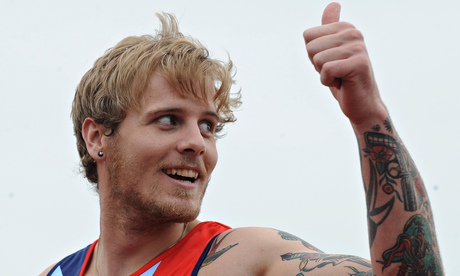
A baffling array of categories in each event spoke of the severity of their injuries, while their presence at the first Invictus Games spoke of the private battles fought to overcome them.
Equal to the grit of the injured servicemen and women on display, and the personal bests beaten on the field at Lee Valley Athletics Centre in London, was the support of the 7,000-strong crowd of family, friends and supporters, including Prince Harry, the Duke of Cambridge and the Prince of Wales, which gave many the boost they needed to make it over the finish line.
The 131-strong team representing Great Britain – which tallied six gold, five silver and four bronze medals by late afternoon on Thursday – had a strong start, taking the first two medals of the athletics, in the 100m. In the category IT1, for single or double amputees below the knee, Alex Tate took first place, ahead of his team-mate, Kushal Limbu.
Speaking after he picked up Britain's first gold, Tate, 24, said: "It was a massive rush. This was my biggest, my best, standing up being cheered as I received my medal. It's crazy. I had a feeling it was going to be a medal. I realised it was going to be close between Kushal and me but I did not think I would have to throw myself over the line."
Tate, who flung himself toward the finish line during the final 10m after suffering a hamstring injury, said the competition was the "best rehab any soldier could have. I was suffering from depression and [post-traumatic stress disorder]. It gave me something to focus on."
Tate, from Bury St Edmunds in Suffolk, lost his left leg after being struck by an improvised explosive device while on patrol with the Royal Anglian First Battalion in Afghanistan in 2012.
Limbu, 32, a veteran with 11 years service with the 2nd Gurkha Rifles, who went on to win another gold, for the 200m, said: "I wasn't hoping for a medal that much. I'm pleased with my silver."
Limbu won in the 100m and 200m in the Warrior Games in the US, but described the Invictus event as "bigger than that. Honestly, this is the biggest event of my military career."
Michaela Richards, who won two gold medals for 400m and 100m in the "open" category, shaving a second from her personal best in the former, said she felt "amazing, really buzzing" after her win.
Speaking after being confirmed as the 400m gold medal winner after a mix-up initially reported her disqualified, Richards, who was in the Royal Navy when she was involved in a car accident that left her with a brain injury in 2011, said: "I couldn't ask for better races, for a better crowd. They were amazing."
She said the service charity, Help for Heroes, had "saved her life" by getting her into sport.
With nine events ranging from wheelchair rugby to sitting volleyball, the Invictus – which means "unconquered" in Latin – uses competition to inspire recovery, rehabilitation and understanding of military sacrifice.
Before the competition began, a drum service, a tradition going back hundreds of years, was held in the in-field. It paid tribute to the sacrifice made by soldiers who fought in the first world war, which began 100 years ago, and remembered those affected by 9/11, which happened 13 years ago on Thursday.
More than 400 competitors are taking part in the Invictus Games. The largest contingents of athletes come from the US, with 97, and the UK, with 131. Many in the audience were also veterans or military personnel.
Jon Sear, 45, a Royal Marines officer, who had come with his wife, Lacey, 47, said they wanted to "celebrate the fact that its possible to come back from injury and still achieve phenomenal performance. It's about taking a minute to reflect on the guys who are here and those less fortunate, who are not."
Some competitors, such as Richards, who has a brain injury, beat their personal bests. She won a gold medal and shaved a second off her previous time in the 100 metres, open category. Others endured.
At one point, during the 1,500m, it looked as though Paata Jibuti, from Georgia, would not finish. Clearly in pain, the 41-year-old faltered a few metres from the finish line. After a massive cheer from the crowd Jibuti picked up speed and ended the race with a flourish. "I felt a very sharp pain," he said through a translator. "But I heard the cheer and it got me through."
Jibuti, one of the six-member Georgia team, lost a hand in the 1993 Georgia-Russia war. He signed up as medic in the second war, in 2008, but was once again injured, this time he suffered a shrapnel wound to his leg.
Andy Grant, from Liverpool, who won the 1500m, said: "It is just amazing to be running round and getting cheered. Especially the commentary – when they say, 'Andy Grant, Royal Marine,' and everyone is cheering, it is an amazing feeling. It has been amazing week to be honest.
"I knew straight away how important sport was just through my rehab, but seeing the guys now, I don't think there is anything more inspiring than seeing a guy who two years ago was lying in a ditch in Afghanistan bleeding to death, and now he is running 100m in Paralympic time."
Grant, 26, a former Royal Marine who lost his right leg in Afghanistan in 2009, explained the irony behind a tattoo on his leg – a Liver Bird with the words "You'll never walk alone". The surgeon who amputated Grant's leg had to rearrange some of the skin to create a stump. "He managed to cut off the word alone so the tattoo now reads You'll never walk."
Prince Harry and his brother mingled with the competitors at the trackside. During a chat with journalists, Harry said he was "thrilled" with the way the games, which he founded after visiting the Warrior Games in Colorado in 2013, have gone so far.
He described Joe Townsend, who at that point had won one gold medal, as "our David Weir", the Paralympian wheelchair athlete who won six gold medals at the 2012 and 2008 games. Townsend, a former Royal Marine who lost his legs in combat in 2008, went on to win three more – the 100m, 200m, 400m and 1500m in the wheelchair category.
