
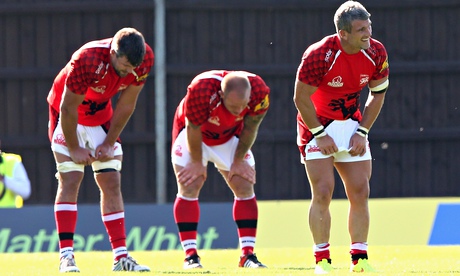
One bad result does not necessarily wreck a season. One paltry crowd is not conclusive proof of declining interest. Mix the two together, though, and the omens are distinctly worrying. London Welsh, beaten 52-0 at home in front of 2,776 paying customers on their Aviva Premiership return, would seem to have a difficult year ahead of them.
Their opening weekend horror show is also potentially awkward news for the Premiership’s organisers, English rugby in general and at least one major broadcaster. The big selling point of the Premiership is its wintry claustrophobia, its relentless competitiveness and the slimness of its margins. Spectators are not supposed to know from one week to the next who is going to win. The struggle to avoid relegation usually guarantees significant interest in the bottom third of the table from start to finish.
Yet, suddenly, a major question mark hangs over all of that. If the Exiles slump to another heavy defeat in Bath this week it does not take a genius to work out their Premiership stay may be brief. The relegation fight, in that event, will be a non-starter and the suspense element at the bottom of the league will instantly evaporate. This, in turn, may well have an impact on attendance figures throughout the league, both live and on TV. People tend not to relish predictable one-horse races, even if their horse is the one doing the romping.
It also raises other uncomfortable issues. Overall, aggregate crowds on the opening weekend were slightly down (1.7%) compared with last season’s opening weekend. Much, if not all of this, was down to the paltry attendance at the Kassam Stadium. With next year’s World Cup looming, Premiership Rugby is seeking more bums on seats, not fewer. If Welsh can barely attract 2,500 people on a glorious September afternoon – and several hundred of those were from Exeter – the all-important end-of-season totals could take a significant hit.
Nor does Welsh’s lacklustre start greatly help those trying to promote the Championship. If the promoted club struggle to be competitive having signed 26 new players, whither automatic promotion? What does it say about the efficacy of the play-off system, which is staged so late in the season it allows scant time for the winners to stitch together a half-decent Premiership squad? Admittedly Bristol and Worcester attracted an audience of 8,549 to Ashton Gate for their weekend game but Bristol were well beaten by Welsh in last season’s play-offs and Worcester lost 20 of their 22 top-tier games. There will always be exceptions to the rule – Exeter, in particular – but bridging the gap is not getting any easier. If that trend continues, there are all sorts of implications.
Black Sunday in Oxford was also sobering, therefore, for Yorkshire Carnegie, Rotherham, London Scottish and Nottingham, all of whom quietly fancy securing Premiership status for themselves. But will it be worth the money and effort? Nine months of pain and misery can seriously damage a club’s self-esteem. Better for some, maybe, not to chase unattainable rainbows, or at least be more realistic about what long-term success actually looks like. The Premiership grass is not always greener.
None of this is intended to heap further misery on Welsh; if anything it reflects the rising standards of professionalism which all ambitious clubs now need to match. And, let’s not forget, there are 21 more rounds of matches to go, plenty of time for the Exiles to rise off the canvas and prove people wrong. It would be some story if they can do so from such a gruesome starting point; hopefully last Sunday was a grisly one-off for all concerned.
But if not? Well, at least it will allow other lower-placed sides to play with more freedom and blood more English-qualified youngsters, the spectre of relegation having been prematurely lifted. Premiership organisers can already point to the 34 tries scored on the opening weekend, compared to 25 last time. The flip side, of course, is that a tournament is only really as strong as its weakest link. If Welsh cannot pull their socks up, the effects will be felt way beyond the Thames Valley.
HIGH LIFE
England will be heading off to Denver, Colorado, for a high-altitude fitness camp next July ahead of the 2015 Rugby World Cup. The idea is to ensure they hit the tournament hard with their bodies in peak condition. It already sounds a far cry from the 2007 tournament in France when, as Lawrence Dallaglio revealed in the Sunday Times at the weekend, things were slightly different.
Keen to escape a sub-par hotel room in Marseille he persuaded his squad-mates Joe Worsley and Peter Richards to accompany him to St Tropez for lunch, as you do. The lobster and rosé were going down a treat when Richards popped off to the loo. In his absence Worsley seized the opportunity to pick up his mobile phone, rifle through his contacts and substitute his own number for the head coach Brian Ashton’s. Shortly afterwards, a text duly arrived, ostensibly from Ashton, revealing there was a scrum-half injury crisis and Richards was needed urgently. Cue near-heart failure on the opposite side of the table, cruelly followed by another text telling Richards not to worry because the management had decided to pick Shaun Perry instead. Only at that point was the panic-stricken victim put out of his misery, after which the party trotted off to a barbecue at Brigitte Bardot’s house. England duly went on to beat Australia that weekend and somehow managed to reach the final. Their big-match preparations this time threaten to be somewhat different.
ONE TO WATCH THIS WEEK
The Pro12 season kicked off in intriguing fashion last weekend with defeats for both Leinster and Munster at the hands of Glasgow and Edinburgh respectively. With the Scottish referendum looming next week, can we expect another brace of Scottish wins, this time against Cardiff Blues and Connacht? On recent evidence the answer could well be “Yes”.
