
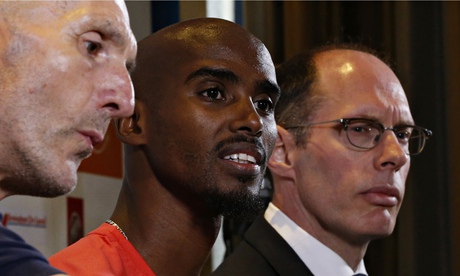
Mo Farah has insisted there was “nothing dodgy” about his gold-medal winning performances since joining his coach, Alberto Salazar, four years ago – and said that he would be willing to publish his blood values because he had nothing to hide.
Farah, a double Olympic and three-times world champion, admitted he was annoyed at being dragged into the doping allegations surrounding Salazar and his training partner Galen Rupp, who took the silver medal behind him at London 2012.
“I am so angry,” he said. “The allegations are about Galen and Alberto but yet if you look at all the papers everything is a picture of Mo, so I feel like my name is getting dragged through the mud.
“I haven’t done anything. It’s about Alberto, so let’s ask Alberto. It has affected my foundation. I don’t want kids to think I am doing something dodgy, when I am not.”
Farah has decided to stay with Salazar’s Nike Oregon project training group because he is yet to see any “clear evidence” of wrongdoing. But he insisted that he would confront his coach after competing in the 1500m in Sunday’s Birmingham Grand Prix.
“As soon as the race is over, I’m going to go back to Portland, and sit down with him, and try to get some clear evidence that shows that this is just allegations,” he said. “If he can’t prove that to me, and the sooner the better, then I am out, 100%.”
British Athletics insist they “have had absolutely no concerns” with Salazar despite this week’s Panorama documentary that alleged the American had, among other things, given Rupp testosterone when he was 16. Salazar and Rupp deny all the allegations. British Athletics also confirmed that Salazar will be staying on as a consultant to its endurance programme. However, it has announced an immediate review of the “performance management system surrounding Mo Farah and the endurance programme”.
According to the performance director Neil Black, who will be on the reviewing panel: “I expect Alberto will demonstrate to us in the ways that I have yet to find out, that those allegations are unfounded. That is our expectation. If that is what he demonstrates and provides us with, then we will be happy. If he doesn’t provide us with that, then like Mo said, he won’t be happy and we will act on it.”
Black also stressed that Farah’s training and preparation was closely monitored by British Athletics and that Salazar was not given free licence with the country’s most successful athlete.
“It’s very important for people to understand that Mo doesn’t function in isolation,” said Black. “We oversee his physiological conduct and testing and the nutritional programme prescription. And all nutritional aspects are signed off and overseen by Ron Chakraverty as the chief medical officer.
“Barry Fudge as the head of endurance has probably spent a year out of the last four years of his life living and working directly with Mo on a daily basis. I must have been over to Portland to the centre there at least six times a year. Everything is overseen by British Athletics.”
The UK Athletics chief executive, Niels de Vos, defended the decision to stick with Salazar as a consultant even though he faced several serious allegations against him. “The easy decision would be to say, let’s walk away,” he said. “The right thing is to say, you have to prove these allegations are not founded. If you can’t prove that we will walk away.”
Farah, though, has no regrets about his move to America. “One of the reasons I joined the Oregon project was to improve by one or two per cent,” he said. “And I remember at the time, before I joined, I was talking to Neil Black and I said: ‘Look guys this is the best thing for me because as an athlete I was finished sixth, seventh.’
“It was a risk I was prepared to take. Do I regret it? No. I’ve won medals as a result. But with what has happened, if there’s questions we want answers. I’m a clean athlete, I’m against drugs, 100%. Anyone caught on drugs should be banned for life.”
