
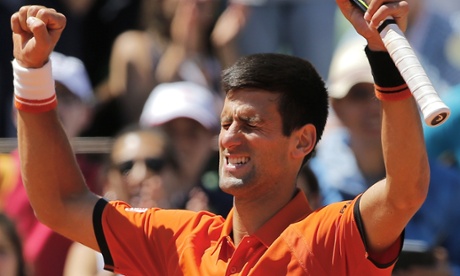
Andy Murray left Paris a day earlier than he would have liked, wounded by an eighth straight loss to Novak Djokovic, but he will arrive at Wimbledon this month with his reputation enhanced, his dignity intact, his position as No3 seed secure and his tennis in excellent shape.
That is a reasonable psychological swag to take from a semi-final of the French Open when the best player in the world rediscovered his inner beast to conclude their long, weather-split duel and beat him 6-3, 6-3, 5-7, 5-7, 6-1 with his eighth ace after an hour in glorious sunshine on Court Philippe Chatrier.
The Scot later sidestepped suggestions that Djokovic had at least stretched the boundaries of propriety when, having been two sets up on Friday night, he took an eight-minute medical timeout after losing the third set in fading light with a storm brewing (both meteorological and metaphorical).
There were echoes – at least in the media’s perception – of the acrimony that surfaced in the Australian Open between them, when Djokovic went on to win the final after appearing to be injured in a tight moment of the first set before roaring back at Murray.
Murray’s tone on Saturday was diplomatic and respectful, but he left enough moral pauses for anyone to draw their own conclusions. It is fair to say they might not play doubles together again.
Asked if the game’s authorities needed to crack down on players taking what appeared to be convenient and perhaps unnecessary breaks, he said: “I’m not getting into that. I said one word after my match with Novak in Australia and it was like I was complaining and trying to be a sore loser. That’s not what it is. Everyone is entitled to take the medical timeouts when required, and that’s what it is.”
Further pressed on whether Djokovic might have benefited from the interruption on Friday night because Murray was building momentum, he said: “I’m not going into that because, no matter what I say, it’s not anything that will be acceptable to anybody.
“It was what it was and the match finished the way that it did. I obviously started well when we came back out today, so it didn’t hinder me.”
Nor did it. He won the fourth set on merit, and Djokovic similarly was irresistible in the fifth. Nevertheless, Djokovic goes through to Sunday’s final against Stan Wawrinka without the popular support his gifts deserve, and the world No1 sounded defensive when it was put to him that he might again be flirting with unethical behaviour.
“I went out from the court instantly as soon as I lost the third set,” he said. “I took my bag and asked for the medical and, after that I was examined. It took some time to get to the locker room, to get on the table and do the treatment. So I don’t see why that is unfair.”
Murray, meanwhile, will be desperate to the point of combustion for his sequence of disappointment against Djokovic to end – preferably on the grass of Wimbledon where he beat him in the final two years ago, or maybe in New York, where he also prevailed for his first slam victory, in 2012.
There was no denying his tormentor this time, however. Under intense pressure, Djokovic revealed his extraordinary thirst for a fight. He also had to handle the subjugated mental strain of almost blowing a two-set lead, something that he had experienced once before here, against Jürgen Melzer in the quarter-finals five years ago.
After a warmup that lacked, well, warmth, Djokovic started surefootedly when they resumed at 3-3, holding to love. Dressed in Dutch orange, he was playing the “total tennis” that had carried him to 40 wins in 42 matches this year – the most significant of them his victory over Rafael Nadal in the quarter-finals on Wednesday.
Murray, workmanlike in plain white T-shirt and black shorts, had to labour to win a long first rally on his serve, and the patrons, so feverishly for him on Friday night, responded in his favour again when Djokovic lobbed long.
Djokovic has two engines: the silent one when relaxed, the grunt-machine when the rallies get longer and tougher. At the end of the longest exchange of the morning, with 32 near-perfect groundstrokes and after being chipped by Murray, he was ready to ignite the grunt-machine.
The French crowd went wild for Murray (with Amélie Mauresmo grinning as wide as anyone), when Djokovic hit wide to present him with two break points. Djokovic saved one with superb, pressing tennis. He overcooked another forehand, however, and Murray served out to level the match after 20 minutes (or three hours and 28 minutes in all).
Djokovic was not entirely friendless, and his supporters (including some in the press seats, it has to be said) cheered wildly when Murray hit long in the second game and the Serb grew in strength and determination, powering on to the finish line for the loss of a single game in that concluding set.
He was proud and relieved as well as generous in victory. “I played some great tennis yesterday. He found his game late in the third. I had many opportunities to finish the match in straight sets, but credit to Andy. He showed why he’s one of the biggest competitors and fighters on the Tour.
“It was a really tough match, more than four hours all together, yesterday and today – no different from any other match that we played against each other. It’s always a thriller, always a marathon.”
As for Murray, he was not as downhearted as he might have been in the past.
“I think my game is back close to where it needs to be to be winning slams,” he said. “With the grass-court season coming up, hopefully I can get myself an opportunity there and play much better this year than last year [when he went out in the quarter-finals of Wimbledon to Grigor Dimitrov]. Physically, I’m in a much better place. We’ll see what happens the next few months, but it’s been a good start to the year.”
