
A few weeks ago the comedian and actor Justin Moorhouse was a guest on BBC Radio 5 Live to talk about football. He is a regular on Fighting Talk and one of the questions this particular week was whether there was anything about the sport that really turned him cold. He barely paused for breath.
“It’s probably going to upset some people but the thing I haven’t got the stomach for any more is the England football team,” he announced. “I’m just so bored with that dreary pantomime. Every couple of years, people who don’t like football get into it. People who support rubbish teams get into it. It’s just boring. I don’t feel English – I feel European. I’m an international man. I don’t believe in borders and flags. I can’t stand England. I can’t stand the carnival. I can’t stand the anticipation. I can’t stand the flags everywhere. I can’t stand the disruption to my life. So the England football team. Go and stick it right up your St George’s Park – and leave it there!”
This is the point when you can think he either deserves a round of applause or an orchard’s worth of rotten fruit chucked at him. Certainly, there are plenty of people who think very differently and it is probably no surprise to learn the station’s phone lines immediately started to flash with complaints. Many of those people may have been to Tallinn, or Basel, or any of those cities where England always seem to pack the away end, and may already be planning future excursions to Rimini, Vilnius and Ljubljana. If you have ever followed a team abroad and know the sacrifices that go with it you will appreciate it is an extraordinary kind of devotion.
Justin happens to live round the corner from me and I haven’t seen an angry mob with burning pitchforks heading his way. On the contrary, I get the feeling there are many other football fans – people who have shaped their lives around going to matches, week in and week out – who have also given the England experience a go, tried to buy into it and, ultimately, left it behind.
I know this might not be universally popular either, but it isn’t particularly easy to summon a great deal of enthusiasm now the Premier League and Championship is about to be broken up for the third time in 10 weeks for another of these international breaks when everything seems to go into slow motion and all the momentum of club football is lost.
A part of that comes from watching an England team that tends to plod through tournaments and qualifying and has stubbornly failed to deliver any sustained excitement since an 18-year-old Wayne Rooney grabbed Euro 2004 by its lapels.
If it feels particularly dreary right now, a lot of blame should be apportioned Uefa’s way for expanding their next tournament to a bloated 24 teams, to the point that England were drawn in a group with Slovenia, Estonia, San Marino, Lithuania and Switzerland, knowing a third-place finish could still see them qualify.
England, for all their limitations, could probably do it with 10 men and it is no wonder the Football Association are trying to arrange friendlies against Spain and Germany and have one booked against Italy in March. They know it is threatening to become the most boring qualification programme in history.
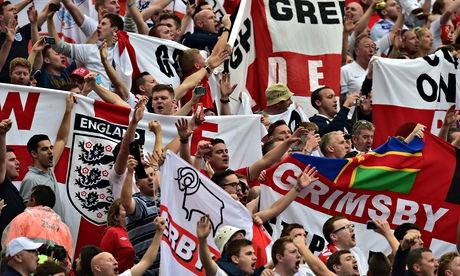
Yet it is strange how the England team polarises so many people. The FA estimate there will be a crowd of around 80,000 for the Slovenia game next Saturday. It is not cheap watching football at Wembley and there is no getting away from the fact that it is a remarkable turnout and the hard evidence for the FA to make their case that people still do care.
The television audiences for the last four matches against Norway, Switzerland, San Marino and Estonia offer a slightly different story: on average, 5 million every game. That makes Roy Hodgson’s team less popular than Antiques Roadshow (5.5 million), Have I Got News for You (5.2 million) and Casualty (5.1 million). To put it in a football context, Manchester United’s FA Cup tie against Crawley in February 2011 pulled in 6.1 million viewers – on a full Saturday of football.
England’s support, though, is still staggeringly good considering everything. Even when the Norway game brought in the worst crowd for an England match since Wembley was rebuilt – 40,181 – it largely went unnoticed that the only international fixtures to beat it that week were Germany against Argentina, Italy versus Holland and France against Spain. Then just look at the numbers England take away, when a lot of their followers regard it is a chance to visit some of the cities and stadiums their club teams will never see.
It is not always easy embracing the England team and everything that goes with it: the culture, the circus, the seemingly endless cycle of tournament failure, the promises it will be different next time and the knowledge that, almost certainly, it won’t be. England lasted six days in Brazil and there is a passage in Luis Suárez’s new autobiography that neatly sums it up. “When people talk about a lack of resources it makes me laugh,” he writes. “If England, over there in the ‘first world’, don’t have the resources, with the quality and quantity of players there are, with the facilities they have, with the economic muscle the game has there, with the millions of players there are, where does that leave the rest of us? Where does that leave Uruguay?”
With England, there is more to it than just the football, though. It is the other stuff, too. We might be past the stage where the opposition’s national anthem is booed and whistled as a matter of routine (until Glasgow on Tuesday week, that is). If you would rather avoid a punch to the head there is less chance of that as well. Yet some of the old habits have been harder to kick judging by the way a familiar old song returned to the setlist in Estonia last month. Think of the tune to Sing Hosanna, just with a very different chorus: “No surrender, no surrender, no surrender to the IRA. Scum!”
Spitting Image once ran a sketch about politically correct football chants whereby the traditional song about referees was changed to an ode praising his ability “to satisfy his own needs manually” and the two-world-wars-and-one-World-Cup ditty was extended to take in Germany’s superior trophy count and politely finish with: “Your economy is also the strongest in Europe, so overall you are the best.”
There will always be chants that remind us why Arthur Hopcraft once wrote: “Football crowds are never going to sound or look like the hat parade on the club lawns of Cheltenham racecourse.” Some of us want to keep it that way, too, and dislike the sanitisation that recently resulted in Liverpool putting a Bart Simpson cartoon on their website telling everyone not to use the naughty word in their Steven Gerrard song. Yet it would be nice to think the volume could be turned down for good on No Surrender. Unfortunately, it doesn’t seem like it will be any time soon.
The next England game will see Rooney join the small band of players to win 100 caps. That the occasion will be close to a sell-out is remarkable given that the football in the Rooney era has occasionally been as bland and irritating as the der-der-der of the England band (a band that is to football what its sponsor, Pukka Pies, is to Michelin stars).
The crowd will have doubled from the Norway game and it is just a shame, perhaps, that Rooney has not played as thrillingly in the last 10 years as he did at Euro 2004, as football’s first assassin-faced baby. Maybe things would be different, and maybe there would not be so many people wishing we could fast-forward this part of the season.
Gutiérrez nears the right end of the long road
It was the photographs from the Buenos Aires marathon that showed what chemotherapy had done to Jonás Gutiérrez. The long dark hair had gone. The beard was no more. His face looked slightly bloated and in his last interview, wearing a baseball cap and almost unrecognisable from the player we knew at Newcastle United, he had talked about his illness as the “biggest match” of his life. Yet he still managed to get round the 26.2 miles on behalf of a charity for cancer sufferers and, at the end, it was a glorious picture of him with his hand in the air.
Gutiérrez’s cancer was diagnosed in Argentina last year. Since then he has had an operation to remove his left testicle and gone through the prolonged suffering that comes with trying to fight the disease. Newcastle’s fans have shown their support by applauding in the 18th minute of matches to mark his shirt number and what a lovely moment that was when Gutiérrez announced he had been given the all-clear, with a return to training cautiously pencilled in for next month.
Gutiérrez probably doesn’t want to be a hero when the alternative is that he can simply go back to being a footballer. Newcastle’s crowd might insist he can be both. It will be some moment at St James’ Park when he makes his comeback.
Ronaldo kicks back to old-school ways
Cristiano Ronaldo will have to try again to pull level with Raúl, and now Lionel Messi, as the leading all-time scorer in the Champions League but he did strike a small victory of sorts at a time when players wear one pink football boot, another blue, and nobody even suggests it might be a fashion faux pas.
Ronaldo is, admittedly, an unlikely campaigner for old traditions but there he was in the Bernabeéu wearing black boots. How nice they looked, too, in this age when photographers got into Manchester City’s boot-room last season and discovered a kaleidoscope of colours (one pair of black boots out of 22, almost certainly belonging to James Milner).
They didn’t bring Ronaldo any luck but hopefully he won’t ditch them in the style of a golfer with a troublesome new putter. Black is the new green, yellow, white, red, silver and gold. More of this, please.
